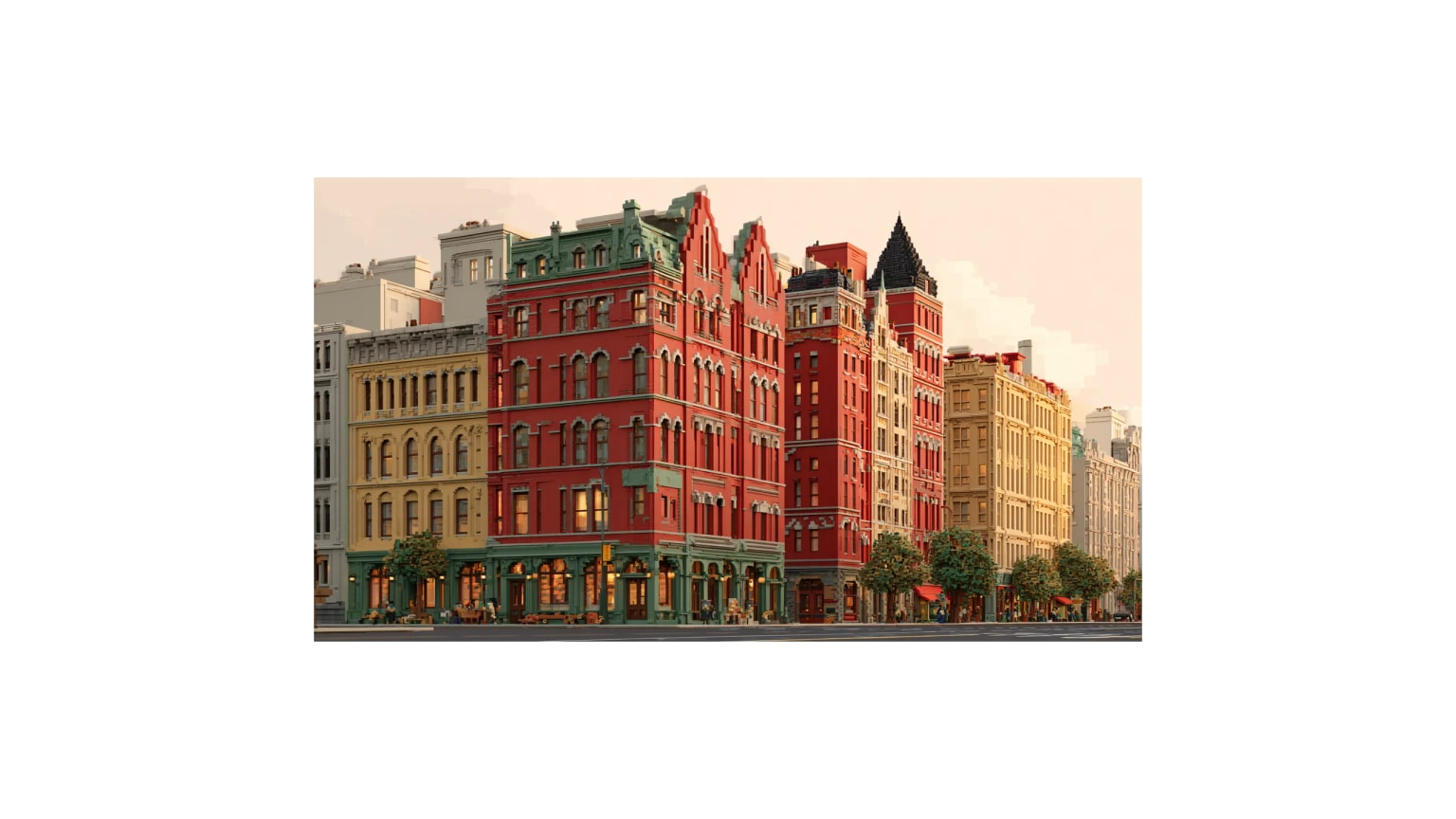
The Art Nouveau Apartment: A User's Manual for High-Quality Urban Life
Art Nouveau—call it Jugendstil, Secession, Modernisme, Liberty—was never just ornament. It was a coordinated urban technology for living well in dense neighborhoods: daylight engineered through bay windows, structural walls thick enough to buffer heat and noise, floor plans that cross-ventilate, stoops calibrated for convivial streets.

Key Insights
Essential takeaways from this chronicle
Art Nouveau apartments (1890–1914) outperform many modern buildings on measurable comfort: daylight factors, cross-ventilation, acoustic isolation, and adaptability
Point 1 of 6Design patterns that work: 4–7 stories, 3.2–3.6m ceilings, dual-aspect flats, courtyards as urban lungs, mixed-use ground floors
Point 2 of 6Thick masonry walls (200–300 kg/m²) provide thermal mass and acoustic isolation; high window heads (≥2.4m) maximize daylight penetration
Point 3 of 6Cities from Paris to Prague, Barcelona to Riga retrofit these buildings using vapor-open insulation, secondary glazing, and courtyard heat pumps
Point 4 of 6Living standards should be measured: daylight factor, nighttime noise <30 dB(A), CO₂ <1000 ppm, retail vacancy <10%, secure bike storage
Point 5 of 6The model is replicable without pastiche: copy the logic (dual aspect, deep reveals, courtyards, active ground floors) not the ornamentation
Point 6 of 6
The Art Nouveau Apartment: A User's Manual for High-Quality Urban Life
This is a practical guide to why these buildings deliver a high standard of living, what design patterns make them work, and how cities from Paris and Prague to Barcelona—and smaller places like Nancy, Oradea, Subotica, and Riga—translate those patterns into today's housing needs without destroying the original fabric. Think of it as "AI language" in the best sense: structured, testable, and eminently usable.
1) Why Art Nouveau apartments feel better than they should
Proportions that do real work
Typical Art Nouveau blocks run 4–7 stories, closing the street as a "room" without canyoning it. High ceilings (often 3.2–3.6 m), deep window reveals, and generous window-to-wall ratios yield daylight factors that modern value-engineered buildings struggle to hit. High mass walls damp temperature swings and noise.
Cross-ventilation by plan, not gadgets
Most flats span from street to courtyard or corner to corner. Two facades = two orientations = pressure differential = air movement. The result is nighttime cooling that works without compressors and a daily purge that makes interiors feel clean.
Courtyards as urban lungs
Even narrow "light wells" were built to code-driven dimensions; larger courtyards act as semi-private parks, with trees that now tower above the eaves. They decouple play, laundry, bikes, and quiet from the street while keeping them social.
Mixed-use ground floors by default
Shops at grade, stoops, concierge doors, carriage passages—each creates a high-frequency interface with the street. The human benefits are measurable: more "eyes on the street," more short-distance errands, more daily walking.
Craft as durability
Stone, brick, lime plasters, ceramic cladding, wrought and cast iron, hardwood doors, terrazzo. Maintenance cycles are long; repairs are visible and teachable. Beauty reinforces stewardship: owners are likelier to fix what they're proud of.
Adaptable interiors
Ring plans and enfilades can be re-partitioned without touching structural walls. Dining rooms become bedrooms; maid rooms become studies; double doors become acoustic buffers. The "bones" enable new lives without demolition.
2) Design patterns (with measurements) you can look for or replicate
Daylight & view:
- Window head height ≥ 2.4 m; sill 0.8–1.0 m for seated views
- Daylight factor targets in main rooms: 2–5%
- Corner bays and bow windows extend angle of view and capture winter sun
Air & thermal comfort:
- Two openable faces per flat; stack effect aided by tall stairwells and skylit halls
- Thermal inertia from masonry; internal insulation must remain vapor-open to avoid interstitial condensation
Acoustics:
- Wall mass ≥ 200–300 kg/m² gives a quiet baseline; timber floors benefit from added mass layers and resilient breaks during retrofit
- Double window strategy (original + inner secondary glazing) beats many single replacements for both heritage and sound
Street interface:
- Entrances ≥ 3 per 100 m of frontage for permeability
- Shopfront depth 4–6 m; ceiling 3.5 m: enough volume for viable small businesses
Shared infrastructure:
- Courtyard trees every 7–10 m; permeable surface ≥ 40% of yard for infiltration
- Dedicated bike rooms off carriage passages; refuse rooms with cross-ventilation
3) City playbook: big capitals and small jewels
Paris (16e, 7e, 5e; Hector Guimard territory)
Pattern: perimeter block with generous courtyards; stone/brick with iron balconies; sculpted doors and lobbies; metro entrances as street jewelry.
Why it lives well: light on two sides, thick walls, ground-floor retail continuity, concierge culture.
21st-century upgrades: secondary glazing behind historic sashes; reversible interior insulation (wood fiber, lime-based plasters); discreet heat-pump condensers in courtyards with acoustic screens; elevator inserts in stair voids or courtyard add-ons.
Metric to track: apartment daylight factor; façade airtightness (n₅₀); interior noise < 30 dB(A) at night.
Barcelona (Eixample; Modernisme)
Pattern: Cerdà's chamfered grid; deep plots with central gardens; heroic balconies and wrought iron; canonical apartment palaces (Casa Milà, Casa Amatller, Casa de les Punxes).
Why it lives well: diagonal winds traverse chamfered corners; inner patios are social micro-parks; every block face is a walking street.
Upgrades: rooftop PV hidden behind parapets; greywater reuse for patio trees; shared heat-pump loops at block scale; cross-laminated timber (CLT) mezzanines to adapt grand rooms without harming façades.
Metric: % of units with dual aspect; courtyard canopy cover; retail vacancy < 10% per façade segment.
Prague (Vinohrady, Letná; Secese)
Pattern: sgraffito and ceramics, deep window bays, tiled stoves, high stair skylights.
Why it lives well: generous widths (often 6–7 m bays) produce flexible rooms; courtyards are quiet service cores.
Upgrades: stove niches become heat-pump indoor units with flue chases reused as services; shared laundry and bike stores reorganize basements.
Metric: air exchange via purge vents; winter indoor RH kept 35–50% without mechanical humidifiers (a sign of envelope discipline).
Vienna (Wienzeile, Margareten; Wagner/Loos-era blocks)
Pattern: Secession façades, majolica tiles, rational plans over Gründerzeit bones.
Why it lives well: street hierarchy + tram proximity; courtyards as calm commons; high entrance density.
Upgrades: district-heat substation optimization (lower return temps), solar thermal on inner roofs, stair cores as ventilation chimneys.
Metric: DH return temperature < 40–45°C; entrance density ≥ 3/100 m.
Brussels (Ixelles, Saint-Gilles; Horta)
Pattern: skylit stair halls; ironwork as structure; narrow but very deep plots.
Why it lives well: stairwells double as daylight engines; compact nearness to parks and cafés.
Upgrades: light shafts receive reflective lining; rear extensions in CLT; micro-heat networks between party walls.
Metric: stairwell daylight factor ≥ 2%; shaft illuminance at noon > 300 lx at ground.
Riga (Alberta iela et al.; Eisenstein)
Pattern: exuberant façades, large flats, corner turrets, sculptural reliefs; among Europe's densest Art Nouveau ensembles.
Why it lives well: large room volumes, cross-ventilation, generous stair halls.
Upgrades: seismic shear discreetly added with CLT cores; interior insulation only where vapor-open; window doubles retained.
Metric: structural deflection under added loads; U-value improvements without condensation (hygrothermal modeling as standard).
Milan & Turin (Liberty)
Pattern: ceramic façades (Casa Galimberti), floral ironwork, glazed corner bays; Via Malpighi / Porta Venezia belts.
Why it lives well: over-wide sidewalks, active porticoes, apartments shaped for cross-breezes.
Upgrades: shared geothermal/air-source hybrids in courtyards; balcony planters as summer shading devices.
Metric: % balconies with shading; summer indoor max temps during heat waves without A/C.
Nancy (École de Nancy) — small city, big quality
Pattern: coordinated craft—glass, iron, furniture—stitched into apartments and shopfronts.
Why it lives well: short-trip city; crafted thresholds keep streets lively.
Upgrades: protected bike corridors tied to existing carriage passages; compact district-heat islands using river-sourced heat pumps.
Metric: household car-kilometers reduced year-over-year; retail churn reduced.
Oradea & Timișoara (Secession in Romania/Hungary)
Pattern: corner palaces (Black Eagle Passage in Oradea) with galleries; richly glazed courtyards.
Why it lives well: arcaded passages make all-weather micro-centers; mixed-use is native.
Upgrades: re-activate galleries with night-lighting and wayfinding; retrofit galleries with discreet fire safety to allow upper-floor co-working or studios.
Metric: passage footfall; evening luminance uniformity; upper-floor vacancy.
Subotica & Szeged (Vojvodina/Hungary)
Pattern: vivid polychrome tile (Zsolnay), civic-minded blocks around squares.
Why it lives well: compact block perimeters, visible craft, integrated tram corridors.
Upgrades: thermal upgrades via interior plasters; reversible exterior storm windows for heritage façades.
Metric: heritage-compatible window U-values; square dwell time.
4) Retrofit without regret: how to modernize and keep the magic
Windows
Keep originals where sound frames exist. Add secondary glazing internally for acoustics/thermal; replace only when frames are beyond repair, and match sightlines. Secondary systems often outperform double replacements for both comfort and heritage.
Insulation
Prefer vapor-open interior systems (wood fiber, aerogel plasters, lime-hemp) to avoid trapping moisture in old brick/stone. Model corners and lintels for mold risk; ventilate kitchens and baths as a system.
Heating & cooling
- Courtyard-facing air-source heat pumps with acoustic baffles; in dense blocks, consider shared heat loops to reduce exterior units
- Where district heat exists, prioritize substation tuning and radiator balancing before any tear-out
- Summer comfort: external shading, light-colored blinds, ceiling fans; design for night purge with secure vents
Services & access
Insert elevators in light wells only after daylight studies; prefer courtyard add-ons with glass lifts that don't break stair skylights. Run new vertical services in existing flues; cap unused chimneys only after venting and moisture checks.
Roofs and energy
Hide PV and solar thermal behind parapets or on inner slopes; keep street-facing planes clean. Use roofs for shared laundry/airing terraces or small green roofs; avoid loads that compromise timber trusses.
Ground floor
Restore shopfront depth and window height; keep multiple doors per frontage. Activate carriage passages for bikes, scooters, and deliveries; light them well.
5) Living standard: how to measure it (quant + qual)
If you claim "high quality," measure it. A simple dashboard a building association or city can maintain:
- Daylight: daylight factor and useful daylight illuminance in living spaces
- Acoustics: nighttime LₙT,w through floors; façade sound levels vs. interior
- Thermal: winter temperature stability (ΔT day/night < 3–4°C without overshoot); summer max temps in heat waves without A/C
- Air: CO₂ levels under occupancy (<1,000 ppm in living rooms under normal use)
- Street life: entrances per 100 m; retail occupancy; pedestrian counts
- Green: courtyard canopy cover; permeable yard %; biodiversity observations (simple citizen-science counts)
- Mobility: secure bike spaces/unit; walk time to daily needs (<10 minutes for groceries/pharmacy)
- Energy: pre/post retrofit energy-use intensity (kWh/m²·yr); % flats with dual aspect
Publish these annually. Quality becomes civic data, not a slogan.
6) How planners, developers, and co-ops can copy the model—without cosplay
Don't fake the lilies; copy the logic
You don't need floral ironwork to achieve Art Nouveau performance. Use its principles: dual-aspect flats, deep reveals, high heads, courtyards with trees, shopfronts with real volume, stairwells that are daylight engines.
Build the five-story perimeter block
It remains the most life-per-meter form we know: enough density to support transit and shops, low enough for sunlight and human-scale streets.
Pair beauty with maintenance
Choose materials that age well and can be repaired locally. Elaborate details are fine if they are legible and maintainable; otherwise, keep the line clean and robust.
Write the retrofit code you wish you had
Allow internal insulation systems that protect masonry; fast-track secondary glazing; set acoustic targets; publish courtyard PV guidelines; give bonuses for dual-aspect layouts; require bike storage in carriage-passage analogs.
Invest in ground-floor economy
No quality of living survives a dead ground floor. Protect small footprint retail, keep business taxes predictable, design for deliveries, and light the pavement.
7) A short atlas of transferable lessons
- Paris teaches threshold craft (doors, lobbies) and silent mass
- Barcelona teaches block-scale ventilation and social courtyards
- Prague teaches plan adaptability and stair daylight
- Vienna teaches network heat and tram-first streets
- Brussels teaches skylight engineering
- Riga teaches ensemble thinking—a district is a work, not just a sum
- Milan/Turin teach tile-and-iron durability
- Nancy, Oradea, Subotica teach that small cities can carry world-class living standards when they value repair and keep their ground floors alive
8) Bottom line
Art Nouveau apartments weren't "luxury." They were careful. They invested in light, air, mass, and thresholds; they mixed use; they expected to be repaired, not replaced. That's why they still feel civilized. If we treat their lessons as a performance spec—measurable, repeatable—we can retrofit them responsibly and design new buildings that inherit their virtues without pastiche.
Urban quality of life is not a mystery. It is a stack: proper proportions, dual aspect, mass and silence, trees in courtyards, active ground floors, and neighbors close enough to borrow sugar. Art Nouveau wrote that stack in stone and iron. The task now is to keep it working—and to build its logical descendants.
Continue Reading
The View from Below: How London Mistook Skyscrapers for Density
London spent twenty years building upward in the name of the compact city. From the pavements of Shoreditch the arithmetic looks different: the tower privatises the panorama and socialises the silhouette.
The Los Angeles That Almost Learned to Walk
In 1930, a regional parks plan and an electric rail network could have made Los Angeles a polycentric, walkable, tram-linked metropolis. The city commissioned the plan, then put it in a drawer. This is the anatomy of a choice, not a fate.
Canals Under Pressure: Amsterdam and the Living City Review
Amsterdam ranks 10th in The Living City Review 2026 with an adjusted score of 76.5. It remains one of Europe’s finest cities for daily life, but housing scarcity and tourism pressure have turned beauty into a harder civic bargain.