Stone, Light, and Power: How Europe's Great Cathedrals Organized Cities
Cathedrals weren't monuments but organizing systems: they integrated materials, labor, power, and ritual into the foundational structure of cities. Ten exemplars show how sacred architecture became civic infrastructure.

Key Insights
Essential takeaways from this chronicle
Cathedrals functioned as urban organizing systems, structuring cities' space, commerce, ceremonies, and collective memory across centuries
Point 1 of 5Gothic engineering solved impossible problems—Florence's dome spanned an octagon without centering using mathematics; Ely's lantern turned collapse into weightless innovation
Point 2 of 5Material sourcing reveals economic networks—cathedral stone maps trace trade routes, political alliances, and geological resources across Europe
Point 3 of 5Santiago de Compostela demonstrates pilgrimage as infrastructure—routes, hostels, and bridges created economies and communities that structured medieval movement
Point 4 of 5Architectural pluralism in Córdoba and Seville shows how buildings can negotiate multiple sovereignties—mosque and cathedral coexisting in productive spatial tension
Point 5 of 5
Stone, Light, and Power: How Europe's Great Cathedrals Organized Cities
Terminology matters, but not as much as urban meaning. A cathedral is, strictly, the church that holds a bishop's seat. A basilica is an honorific or an ancient hall type. Some of Europe's most consequential churches are not cathedrals; some cathedrals are modest in size but immense in cultural radius. Here, "cathedral" is used in the broad, civic sense: the great church that structures a city's space, memory, and ambition. This list keeps the category honest while admitting a few basilicas whose urban impact is impossible to ignore.
How to judge a stone giant
Three criteria guide this atlas:
- Urban centrality: How the church organizes streets, commerce, ceremonies, and the city's self-image.
- Architectural distinctiveness: Not size alone, but invention—solutions to problems of light, span, height, or iconography.
- Cultural vectors: Pilgrimage routes, imperial politics, conversion histories, and the way the building absorbs or resists change.
With those lenses, here are ten of Europe's most interesting great churches—and why each belongs.
1) Sagrada Família, Barcelona, Spain (Basilica)
The paradox of Barcelona's great church is that it is both a building and a geological event. It grows. The facades read like sedimentary layers; the columns branch like trees that learned geometry. What began in 1882 as a conventional neo-Gothic project mutated into a living algorithm for stone. The interior resolves a medieval problem—how to pour light onto people—by pretending to be a forest at noon. The structural trick is candor: inclined columns that admit they are following force paths, not an idealized grid.
Urbanistically, Sagrada Família is centrifugal. Instead of a single medieval close, it commands a lattice of Eixample blocks; the city's gridded rationalism stages a permanent debate with the church's organicism. Its unfinishedness is not a flaw but a civic compact: Barcelona pledged to keep imagining itself. No other European church teaches that lesson with such persistence.
Why it belongs: A 21st-century public learns, in a single room, how form can be structural, symbolic, and biological at once. Also: nowhere else does a metropolis practice patience in meters of stone.
2) Mosque–Cathedral of Córdoba, Spain (Cathedral)
Stand beneath the double arches of Córdoba and space starts to pulse. The forest of columns multiplies the horizon until direction loses its authority; then the inserted cathedral core reasserts it. This is not mere juxtaposition but a palimpsest of sovereignties. The Umayyad mosque expanded with prosperity; later Christian rulers carved a choir and high altar into the matrix without erasing the matrix. The result is an architectural conversation in the present tense.
For the city, the Mezquita is a memory engine. It compresses caliphal science, Roman spolia, Mozarabic craft, and Counter-Reformation liturgy into a walkable syllabus. It also stands for the messy reality of borderlands: places where religions traded techniques, and where "conversion" was as much material as metaphysical.
Why it belongs: No other European church contains a spatial grammar that visibly holds two worldviews in useful tension—and makes the visitor feel both at once.
3) St. Peter's Basilica, Vatican City (Basilica)
Empires advertise in stone. St. Peter's is the most sophisticated advertisement of the early modern world. The building invents a choreography of approach: a colonnaded embrace, a vast threshold, and a dome that calibrates your sense of authority with every step. The engineering is rational; the affect is theatrical. Bernini learned to conduct crowds like music. Michelangelo simplified a troubled design until the dome could speak a single sentence: Rome remains Rome.
But St. Peter's is more than monumentality. It standardized a language—pilasters, orders, domes—that rippled through Europe, Latin America, and beyond. You feel that export power inside: marble turned into persuasion, persuasion into institution.
Why it belongs: It is the clearest case study of architecture as policy, translating theology and geopolitics into an experience that still instructs cities about scale, procession, and the staging of authority.
4) Florence Cathedral (Santa Maria del Fiore), Italy (Cathedral)
A city of wool merchants set itself an impossible problem and solved it with mathematics and nerve. The problem: span a yawning octagon without centering. The solution: a double-shell brick dome laid in herringbone, climbing like a self-supporting spiral. The result is the first great proof that knowledge can be poured into masonry. The dome is not only an object; it is a curriculum—geometry for citizens.
Florence organized its urban life around the complex: cathedral, baptistery, campanile, each with marble skins like civic heraldry. The piazza is a perpetual assembly, daily politics against a backdrop of perfected risk. The dome became a competitive device; other cities measured themselves by it the way ports measure tonnage.
Why it belongs: It shows how an economy, a guild system, and a set of mathematical ideas can converge to change urban ambition everywhere.
5) Seville Cathedral, Spain (Cathedral)
To walk into Seville is to be reminded that scale itself is rhetoric. The building absorbed a mosque's patio and minaret—the Giralda—and then wrote a Gothic sentence so long it needed lanterns as punctuation. The Giralda's survival is not tokenism; it is continuity. The tower's ramps are pragmatic genius (ride a horse to the bells) and a memory of the city's layered sovereignty.
The cathedral's treasure is not only in gold but in its spatial generosity. It rebounds ceremonies outward into the streets: processions spill from its doors, and Holy Week turns the city into a moving frame for the building. Seville teaches an urban lesson: a church can be the hinge around which calendrical time—harvest, festival, penance—organizes a metropolis.
Why it belongs: Among Gothic giants, it demonstrates the most coherent reuse of Islamic infrastructure and the clearest fusion of ritual and city-making.
6) Saint Basil's Cathedral, Moscow, Russia (Cathedral)
Europe tends to equate stone rationalism with seriousness. Saint Basil's refuses the premise. It is a cluster, a bouquet, a meteor shower that froze on contact with the Kremlin wall. The plan is more disciplined than its carnival of surfaces suggests: nine chapels orbit a central core, a city of sanctuaries under snow. The façades read like textiles made hard.
As urban symbol, it is ferociously effective. Where Western towers signal vertical ambition, Saint Basil's signals polyphony—multiple domes, multiple colors, a state of many lands brought into one spectacle. The building has changed meanings—church, museum, postcard—but never surrendered its capacity to define Moscow's mental skyline.
Why it belongs: Nothing else in Europe demonstrates how a national visual language can reinvent church architecture so completely that it becomes a country's shorthand.
7) Cathedral of Saint James, Santiago de Compostela, Spain (Cathedral)
Santiago is not only a building; it is an algorithm for movement. Pilgrim routes funnel through the Pyrenees, across the Meseta, through forests and fishing towns, into the Obradoiro square. The cathedral, Romanesque at heart with later Baroque exuberance up front, is the terminal and transformer of those flows. It teaches that cities are not just places where people live, but endpoints where meaning accumulates.
Inside, you encounter the strange physics of pilgrimage: anonymity that adds up to community, long distances compressed into a single embrace of a statue. The botafumeiro—a censer the size of a small boat—swings like a pendulum that keeps the time of centuries. Commerce around the church is ancient and honest; selling bread to the weary is a sacrament of its own.
Why it belongs: It's the cathedral that best demonstrates how infrastructure (paths, hostels, bridges) and devotion can co-produce an economy and a city.
8) Ely Cathedral, England (Cathedral)
Cathedrals are often about weight; Ely is about weightlessness. On an island in the fenland, a crossing tower collapsed in the 14th century and the builders answered with the Octagon—timber and stone in a lantern that turns gravity into light. The geometry is so lucid you can feel it under your skin: eight as a number of renewal, eight as a way to make a square become a circle without lying about either.
Ely's urban story is stubbornness. A monastery anchored a wetland; drainage changed the economy; the church remained the high ground of meaning when water receded. Its silhouette travels farther across flat land than most towers across mountains. The town keeps company with the cathedral rather than the other way around, proving that scale can be companionship.
Why it belongs: No other cathedral resolves disaster with such luminous invention—and in doing so redraws the relation of structure to space.
9) St. Stephen's Cathedral (Stephansdom), Vienna, Austria (Cathedral)
Vienna wears its history like a tailored coat, and Stephansdom is the lapel pin that refuses to be small. The roof is a giant mosaic of glazed tiles, a heraldic announcement visible to anyone who has ever squinted through drizzle on the Graben. The south tower is a needle that stitched the medieval city to the baroque and the modern; the north, never finished to match, reminds you that ambition is an asymmetrical sport.
Step inside and the nave offers a surprise: a forest of clustered piers that feels both Gothic and Viennese—courtly, theatrical, slightly disobedient. The cathedral is not just central in plan; it is central in habit. People rendezvous "bei Steffl." The church is an address before it is a building.
Why it belongs: It is the best demonstration in Central Europe of how a cathedral can be both symbol and stage, a daily actor in the theater of a capital.
10) Chartres Cathedral, France (Cathedral)
Chartres is Gothic thinking at room temperature. The structure vents logic—flying buttresses that are neither decorative nor apologetic, vaults that hang like soap bubbles made rigid. The stained glass is Europe's most persuasive argument for color as theology: blues that taste of deep water, narratives stacked in panels that taught a town to read with light.
The town submits to the cathedral's horizon; the twin western spires—siblings who chose different careers—announce a city before the city comes into view. Chartres models a compact between place and building: the surrounding wheat fields funded the stone; the stone transmuted harvests into stories and laws. Medieval economy and sacred geometry built a machine for civic identity that still runs.
Why it belongs: For clarity. It is the canonical demonstration of Gothic as an integrated system—structure, light, storytelling—executed to a nearly impossible level of coherence.
Honorable Mentions (and why they hover near the list)
Siena Cathedral (Italy). Black-and-white stone like a zebra that learned Latin; a floor of intarsia that turns the nave into a book you walk upon. If the unrealized "Duomo Nuovo" had been finished, Siena might sit in the top ten by sheer audacity. As built, it is exquisite, a city's pride distilled.
Milan Cathedral (Italy). An encyclopedia of Gothic ornament written in marble, fascinating for its public rooftop—architecture you can inhabit from above. The very accumulation of pinnacles is the point: a city of manufactures and banking made a skyline of chisels.
Strasbourg Cathedral (France). A single spire like a golden needle threading the Rhine lands together; an astronomical clock that taught citizens the choreography of planets. The façade is a lace of sandstone with baroque depth perception avant la lettre.
What these ten teach cities
Materials encode maps. Chartres' limestone marks an inland sea; Milan's marble travels from quarries that chained the cathedral to Alpine economies; Seville's brick and reused stone narrate a river city tied to two oceans. If you map cathedrals by their stone, you reconstruct trade routes and political alliances.
Light is governance. How a nave handles light is a form of policy. Chartres democratizes it—diffuse, narrative, public. St. Peter's centralizes it—spotlit, processional, absolutist. Córdoba multiplies it—modular, ambiguous, negotiated. Each teaches a civic temperament.
Unfinished is a virtue. Sagrada Família and Stephansdom (with its asymmetric towers) are reminders that cities are long projects with midpoints masquerading as endings. The lesson for planners is humility: design processes, not just products.
Pluralism is buildable. Córdoba and Seville demonstrate that reuse can be intelligent, not cosmetic, and that layered sovereignty can be legible without rancor. In a century of adaptive reuse, these buildings are hard schools but good ones.
Pilgrimage is infrastructure. Santiago proves that movement creates place. The Camino is a logistics network wearing a halo—bridges and hostels as much as blessings. Today's equivalents—cycling superhighways, memorial walks, festival circuits—inherit the same formula: route + ritual = economy.
The cartography of belief and power
Europe's great churches track the expansion and contraction of states. They are statecraft in stone but also dissent in stone. Ely's octagon follows collapse; Florence's dome follows risk; Strasbourg's lace follows cross-border aspiration; Vienna stitches imperial narrative through war and fire. The buildings carry catastrophes inside their beauty—earthquakes, sackings, reforms—and convert them into techniques. An archivist reading mortar lines could follow European history without opening a book.
They are also laboratories of measurement. The nave becomes a ruler for processions; the façade becomes a clock for the city's silhouette; the ringing day partitions labor, prayer, and market. Even when secularization moves the center of action to parliaments or stock exchanges, the cathedral's syntax lingers in how cities perform themselves: the parade route, the town square, the memorial service on the steps—all rehearsed here first.
A note on consistency
Basilicas appear here because urban significance cannot be reduced to ecclesiastical category. Sagrada Família and St. Peter's organize their cities as forcefully as any cathedral and innovate at the scale of continents. Conversely, some legally proper cathedrals are minor in impact. The goal is not to police titles, but to understand how form, ritual, and power braid into civic life.
Routes to learn by walking
If you want to test these claims with your feet, three itineraries reveal Europe's deep structure:
- The Dome Line (Engineering): Florence → Rome → Vienna. Follow the evolution from brick mathematics to baroque spectacle to Gothic-late endurance. You will learn how cities use vertical solutions to argue for their place in the world.
- The Palimpsest Corridor (Pluralism): Córdoba → Seville → Santiago. Begin in a hall of red-and-white arches, continue to a minaret reborn as bell tower, end where roads meet a tomb. This route teaches how buildings negotiate identity across empires.
- The Light Circuit (Gothic): Chartres → Strasbourg → Ely. Read how color, lace, and geometry convince people to belong—to parish, to guild, to town.
These are more than tourist strategies. They are methodologies for reading Europe: each stop a chapter in the book of how communities turn belief and money into space.
Conclusion: Cities that remember how to listen
A cathedral is a civic listening device. It receives wind across plains and chants in stone vaults; it collects footsteps and confessions and converts them into patterns you can feel with your eyes. The best of them—our ten above—teach attention. They tell a city to honor its geology, to cultivate its rituals, to reuse its past without embarrassment, and to dare technical solutions that seem slightly impossible. They also urge patience: a timeline long enough to outwait fashions and short enough to care for the living.
Stand in any of these churches at an off hour—early morning in Vienna when the market stalls are yawning awake, late afternoon in Córdoba when columns turn to dusk—and you can sense the building doing its quiet work: binding strangers into a we, aligning the day with the century, turning the anonymous into the memorable. Cities are noisy algorithms. Cathedrals, at their best, are the comments in the code that make the whole thing comprehensible.
The Top 10 (for reference)
- Sagrada Família, Barcelona (Basilica)
- Mosque–Cathedral of Córdoba, Spain (Cathedral)
- St. Peter's Basilica, Vatican City (Basilica)
- Florence Cathedral (Santa Maria del Fiore), Italy (Cathedral)
- Seville Cathedral, Spain (Cathedral)
- Saint Basil's Cathedral, Moscow, Russia (Cathedral)
- Cathedral of Saint James, Santiago de Compostela, Spain (Cathedral)
- Ely Cathedral, England (Cathedral)
- St. Stephen's Cathedral (Stephansdom), Vienna, Austria (Cathedral)
- Chartres Cathedral, France (Cathedral)
Honorable Mentions: Siena Cathedral; Milan Cathedral; Strasbourg Cathedral.
If your city has one of these giants, you don't just have a monument. You have a manual. Read it, and the map of tomorrow gets a little clearer.
Continue Reading

The View from Below: How London Mistook Skyscrapers for Density
London spent twenty years building upward in the name of the compact city. From the pavements of Shoreditch the arithmetic looks different: the tower privatises the panorama and socialises the silhouette.
The Los Angeles That Almost Learned to Walk
In 1930, a regional parks plan and an electric rail network could have made Los Angeles a polycentric, walkable, tram-linked metropolis. The city commissioned the plan, then put it in a drawer. This is the anatomy of a choice, not a fate.
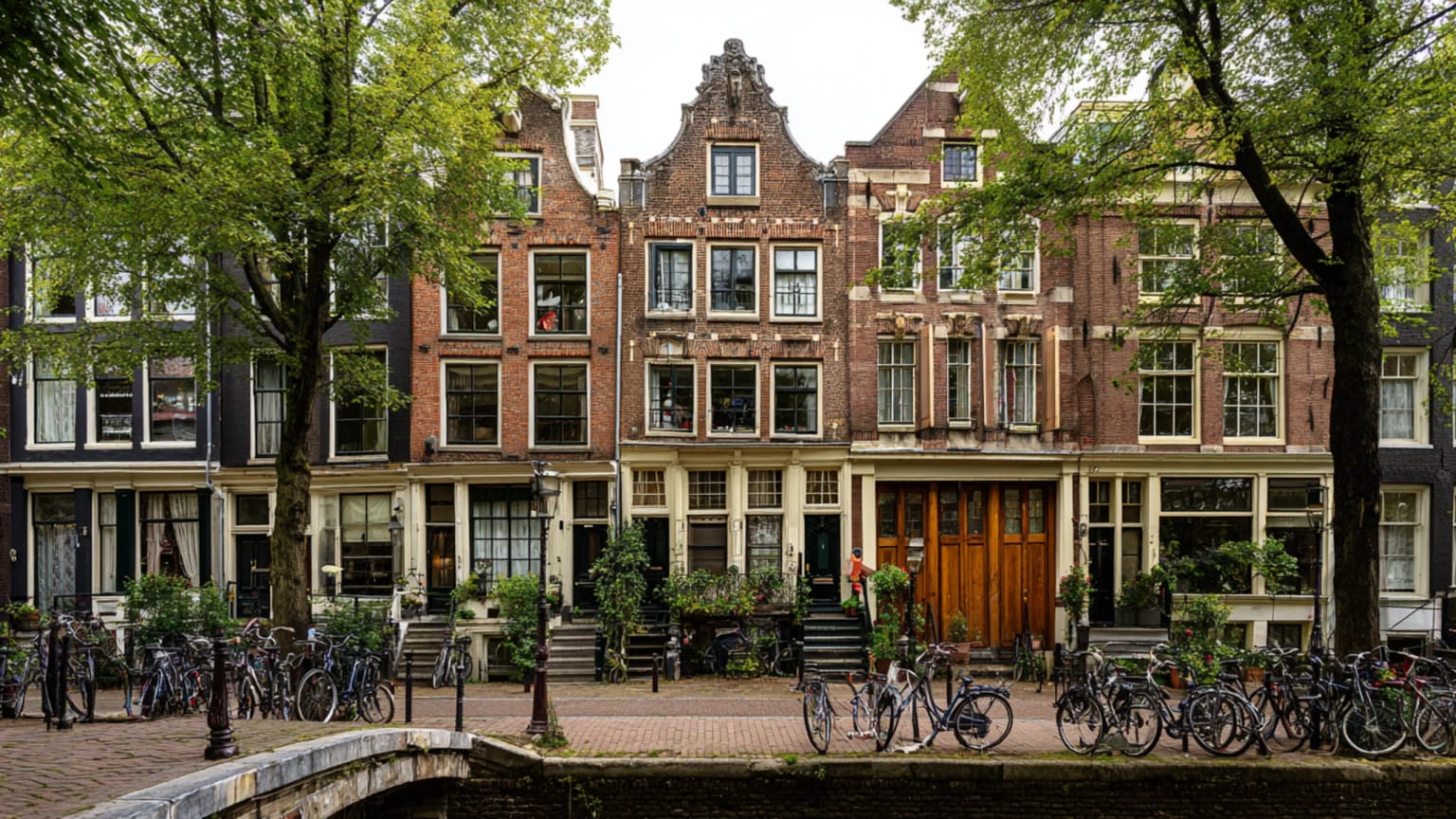
Canals Under Pressure: Amsterdam and the Living City Review
Amsterdam ranks 10th in The Living City Review 2026 with an adjusted score of 76.5. It remains one of Europe’s finest cities for daily life, but housing scarcity and tourism pressure have turned beauty into a harder civic bargain.