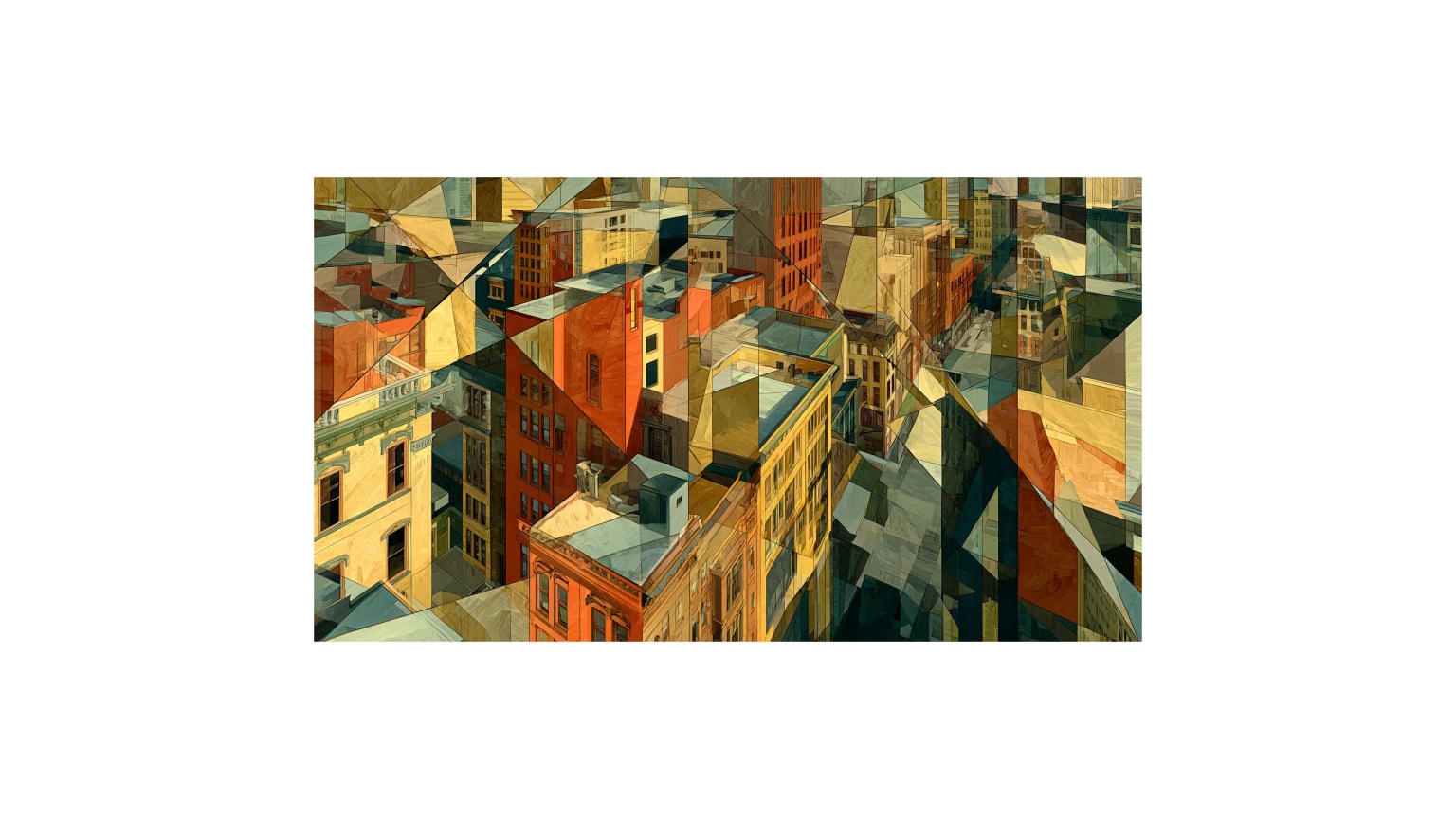
Learning Forward from Art Nouveau, Part II: A Design Playbook for the Next-Century City
Art Nouveau taught us that good geometry and human-scale engineering are productivity tools for happiness. This sequel assembles a pragmatic code: what to keep, what to improve, and where the biggest opportunities lie for climate, comfort, mobility, and cost. When the city is run like good software—clear interfaces, reliable defaults, honest metrics—everyone debugs less and enjoys more.

Key Insights
Essential takeaways from this chronicle
The mid-rise sweet spot (5–7 storeys) delivers transit-supportive density without losing sunlight, cross-ventilation, or street legibility—H/W ratio ~1:1 balances enclosure and daylight
Point 1 of 8Protected bike lanes at 2.5–3.8m preferred width with buffers enable all-ages mobility; Copenhagen's 45–62% cycling mode share proves consistent investment works
Point 2 of 8Courtyard micro-forests reduce local air temps by 1–3°C; trees + permeable surfaces + rainwater capture = measurable public health infrastructure
Point 3 of 8Energy-positive blocks are plausible: rooftop PV + facade BIPV (≥68% of roof potential) + heat-pump loops can meet RIBA 2030 targets (<35 kWh/m²·yr homes, <55 non-domestic)
Point 4 of 8Close the performance gap: require POE (post-occupancy evaluation), disclose EUI, tie incentives to verified in-use data—many buildings use 2× modelled energy without commissioning
Point 5 of 8Material passports + design-for-disassembly + embodied carbon caps (LETI/RIBA pathways) turn buildings into future material banks and shrink whole-life carbon
Point 6 of 8Barcelona's Superblocks show measurable NO₂/PM reductions and improved well-being; geometry edits + space reallocation = public health gains at network scale
Point 7 of 8Outcome-based codes shift from promises to meters: publish EUI dashboards, solar maps, bike-network gaps, canopy cover, and retail vacancy as civic data—quality becomes transparent, not a slogan
Point 8 of 8
Learning Forward from Art Nouveau, Part II: A Design Playbook for the Next-Century City
This sequel moves from looking backward with admiration to looking forward with a builder's intent. It assembles a pragmatic code: what to keep, what to improve, and where the biggest opportunities lie for climate, comfort, mobility, and cost. Think of it as a standards sheet for high-quality, low-carbon "normal living"—with clear numbers, not just moods. When the city is run like good software—clear interfaces, reliable defaults, honest metrics—everyone debugs less and enjoys more.
⸻
1) First Principles, Upgraded
The mid-rise sweet spot (5–7 storeys)
At this height, you can achieve transit-supportive densities without losing sunlight, cross-ventilation, or the legibility of the street. Urban comfort correlates strongly with the height-to-width (H/W) aspect ratio of streets; a band around ~1:1 typically balances enclosure and daylight, with small shifts by latitude, orientation, and prevailing wind. Peer-reviewed urban-canyon literature shows that H/W interacts with orientation and greenery to shape thermal comfort; deeper canyons reduce summer radiation but must be paired with airflow and trees to avoid stagnation.
Perimeter blocks around real courtyards
Cerdà's Barcelona grid remains the clearest case study: ~113.3 m blocks, chamfered corners for visibility and air, streets stratified at 20/30/60 m widths, and an original max height near 16 m. It wasn't decorative geometry; it was a life-support system. Chamfers open intersections, reduce conflict, and create micro-plazas for today's bikes and deliveries.
Ground floors that actually work
Frequent doors, tall shopfronts, service passages reimagined as bike rooms and micro-logistics bays—this is how you shorten errands from an afternoon to a stroll. The unglamorous trick: penetrate the façade with entrances every ~30–35 m (or more), which multiplies "useful proximity."
Bikes as first-class citizens
When cycle tracks are protected and sized generously, they behave like a second transit system. The NACTO guide sets rideable widths of ~2–2.1 m minimum for one-way protected lanes, with preferred 2.5–3.8 m, and buffers ~0.6–1.5 m (wider next to parking). Dutch and European comparisons converge on ~2.5–3.0 m per unidirectional lane and ~4.0 m for two-way tracks as sensible norms. Treat these as performance specs, not aspirations.
Retrofit first; count whole life
Operational energy matters, but embodied carbon is the silent heavyweight. Industry frameworks (LETI, RIBA) now give concrete targets and methods and keep repeating the unromantic truth: the greenest building is often the one already standing, if you can make it perform.
⸻
2) The Near-Future Toolkit: Where the Big Wins Live
Let's map the next decade's most leverage-rich opportunities—moves that scale from a courtyard to a city and stack benefits across mobility, heat, energy, and public health.
2.1 Superblocks & Quiet Networks (space, health, and courage)
Barcelona's Superilles program is not a miracle; it's a geometry edit. Slow the inside of the block, push through-traffic to the perimeter, and reassign freed surface to trees, benches, and games. Health and pollution studies in pilot districts report significant NO₂ and PM reductions and measurable gains in perceived well-being, sleep quality, and social interaction. Scale plans estimate that hundreds of superblocks could prevent hundreds of premature deaths annually through cleaner air and more active mobility.
For cities without Barcelona's grid, the principle remains portable: bundle small streets into slow "rooms," network them, and give arterials protected cycle capacity. Copenhagen's steady investment produced world-benchmark cycling mode shares (often ~45–62% of work-and-study trips in recent years), backed by "green-wave" signal timing, bridges, and coherent maintenance. Cities don't "become bike cities"; they procure them.
Design note: Specify protected one-way tracks on both sides of the street as default (two-way only where crossing logic is clean). Use the NACTO/CROW widths above; set buffers where car doors and trucks live. Publish this as a city standard.
2.2 Courtyards as Climate Engines (trees that do math)
Courtyards with canopy and permeable ground aren't just pretty—they cool streets and apartments. Reviews and field studies show urban trees reduce near-surface air temperature by degrees that matter for mortality, especially in hotter, drier climates (with adequate water). The EPA documents how green roofs and tree cover cut urban heat islands and reduce cooling loads; meta-analyses show canopy expansion can shave 1–3 °C locally, and in some climates, tree implementation drives even larger peak temperature drops. This is public health as landscaping.
Design note: In new or retrofitted blocks, treat the courtyard like a utility plant. Aim for ≥40% permeable surfaces, continuous soil volumes, and tree spacing ~7–10 m. Combine canopy with cool roofs, green roofs where structure permits, and cross-ventilated stairwells acting as summer purge shafts.
2.3 The Rooftop & Facade Solar Dividend (turn walls into power plants)
Mid-rise blocks have generous roof-to-floor ratios, making them solar-rich. The EU's updated building policy package and Solar Energy Strategy push design teams to consider solar at concept stage; Article 10 implementation guidance clarifies obligations for public buildings and lays out pathways for streamlined permits and solar-ready design. At urban scale, building-integrated photovoltaics (BIPV) on facades can rival a city's rooftop potential in the right orientations, and new reviews argue that facades may deliver ~70% of rooftop output on average (sometimes more), which is huge in dense cores where roofs are crowded with mechanicals.
Design note:
- Require solar-ready roofs (structure, anchors, pathways, parapets) and evaluate facade BIPV on south/west faces early.
- Bundle solar thermal for domestic hot water where heat-pump loops would benefit from preheat.
- Publish massings with annual solar maps so design teams can see the PV shadow penalties of pushing beyond 7 storeys on narrow rights-of-way.
2.4 Circular Construction by Default (stop landfilling your supply chain)
Circularity isn't a slogan; it's a set of contracts and checklists. Level(s)—the EU framework for sustainable buildings—includes indicators for design for deconstruction (DfD), while ISO 20887 and related guidance translate intent to details: reversible connections, accessible fixings, standardized modules, material passports. Platforms such as Madaster operationalize materials passports, enabling owners to inventory components, track embodied carbon, and plan for reuse. Cities can make this boring and universal by requiring DfD checklists and digital building logbooks at planning submission.
Design note:
- Set embodied-carbon caps by typology, aligned with LETI and RIBA 2030 pathways, and demand component-level take-off and disclosure.
- Incentivize adaptive reuse first; the National Trust's research quantified the environmental value of reuse over rebuild across typologies.
2.5 Close the Performance Gap (measure in use, not in PowerPoint)
Decades of post-occupancy studies show a consistent performance gap: many buildings use far more energy in operation than predicted. The remedy is managerial, not mystical: commit to POE (post-occupancy evaluation), disclose energy use intensity (EUI), commission building systems properly, and use outcome-based ratings (e.g., NABERS-like). RIBA's 2030 Challenge turns this into numbers: <35 kWh/m²·yr for homes and <55 kWh/m²·yr for non-domestic buildings by 2030. Treat those as hard targets, not "nice-to-have."
Design note:
- Tie incentives to verified in-use performance (12–24 months data), not modelled claims.
- Fund "soft landings" and user training; many failures are operational, not architectural.
⸻
3) The Geometry Code (with Numbers You Can Build From)
Block length: 100–120 m. Corners chamfered or relieved with pocket plazas. This scale keeps walks short and courtyards large enough to matter. Cerdà showed its durability.
Street proportion: Target H/W ~1:1 for main streets, within 0.7–1.2 by climate band and orientation. Use canyon studies to tune for heat and winter sun; plant and ventilate accordingly.
Height: Default 5–7 storeys; step to 3–4 on narrow lanes, and allow 8–10 only when daylight, wind, and overshadowing studies clear. The human-scale argument is both perceptual and energetic.
Courtyards: ≥2,000 m² where block size permits; ≥40% permeable; continuous soil; tree spacing 7–10 m; dual-aspect units wherever feasible for cross-ventilation. (Courtyards are your passive cooling plant.)
Bikes: One-way protected lanes 2.5–3.8 m preferred rideable width with 0.6–1.5 m buffers; two-way ≥3.0–4.0 m when crossing logic is clean and volumes warrant. Copenhagen-level networks require continuous treatment at intersections, daylighted corners, and tight motor turning radii.
Energy: Outcome targets aligned with RIBA: <35 kWh/m²·yr (residential), <55 kWh/m²·yr (non-domestic). Require embodied-carbon disclosure and set declining caps in line with LETI/WLCN.
Solar: Solar-ready roofs and facades; publish annual solar exposure maps per parcel; consider BIPV on sun-exposed facades to supplement roofs in dense cores.
⸻
4) Five Future Opportunities to Seize Now
Opportunity A: Energy-Positive Perimeter Blocks
What it is: A mid-rise block that generates as much energy as it uses annually, using solar roofs, selective BIPV facades, heat-pump networks, and demand management.
Why it's plausible:
- Roofs carry PV; facades cover afternoon/evening loads. Studies estimate facade PV potential ~68% of rooftop potential on average, which sharply raises the cap for dense districts.
- Heat-pump loops at block scale allow sharing between apartments with differing profiles (and feed from solar thermal).
- EU policy is aligning permitting and obligations for solar on buildings—meaning fewer bureaucratic stall points.
What to standardize:
- In planning codes, mandate solar-ready design (structure, parapets, maintenance paths).
- Offer expedited approval if EUI and whole-life-carbon thresholds are met with verified PV yield models.
Opportunity B: Courtyard Micro-Forests as Public Health Infrastructure
What it is: Treat every inner yard as a cooling and wellness device, with tree diversity, soil depth, and water harvesting as hard specs.
Why it works: Multiple reviews and field studies show trees reduce local air temperatures by 1–3 °C on average, sometimes significantly more; they also reduce heat-mortality risk. Green and cool roofs further dampen peak loads.
What to standardize:
- Set a canopy target per block (e.g., ≥30–40% cover in courtyards over 10–15 years) and publish a species list tuned to the local climate (diversity avoids die-off; wrong tree, wrong place can even create night-time heat problems).
- Require rainwater capture and irrigation loops so trees can keep transpiring through heatwaves.
Opportunity C: Outcome-Based Codes & POE by Default
What it is: Shift approvals and incentives from promises to metered performance. Make post-occupancy evaluation routine for public buildings and large private projects.
Why it works: The "performance gap" is well-documented; many buildings consume roughly 2× modelled energy without commissioning and feedback. RIBA's 2030 targets set the scoreboard; POE and NABERS-style ratings keep everyone honest.
What to standardize:
- Require 12–24 months of data disclosure for major projects; tie density bonuses or fee rebates to verified outcomes.
- Use CIBSE TM54/NABERS-like methods in design for realistic predictions and operational alignment.
Opportunity D: Material Passports & City-Scale "Urban Mining"
What it is: Every new building submits a material passport into a city registry; every major retrofit updates it. When demolition looms, the city auctions components for reuse before scrap.
Why it works: EU Level(s) and digital building logbooks are converging on shared data structures. Platforms like Madaster already generate passports and residual value calculations. Reuse shrinks embodied carbon and builds local supply chains.
What to standardize:
- Make DfD checklists mandatory: reversible connections, standardized modules, accessible fixings.
- Set landfill taxes that reflect carbon cost, then recycle receipts into reuse depots and testing labs.
Opportunity E: Bicycle Logistics & "Super-Door" Ground Floors
What it is: Retrofit carriage-passage analogs as bike logistics spines: secure bike rooms, last-mile micro-depots, shared cargo-bike fleets, and waste rooms with through-venting.
Why it works: Streets that shorten errands lower VKT (vehicle-kilometers traveled). When you add protected cycle tracks at the NACTO/CROW widths, you create an all-ages, all-abilities network that quietly outcompetes short car trips. Copenhagen's data across a decade confirms that consistent investment buys high mode share.
What to standardize:
- Minimum entry frequency (≥3 entrances per 100 m) on mixed-use frontages.
- Dedicated, ventilated bike lobbies at grade; power and racks for e-bikes and cargo bikes.
⸻
5) City Playbook: How to Implement in Different Contexts
Paris
- Geometry: Respect the Haussmann cornice line; keep H/W ~1:1 on boulevards; retrofit inward to unlock green courtyards.
- Mobility: Protect cycle tracks to 2.5–3.0 m one-way; prioritize intersections and calm side streets for children's independent mobility.
- Carbon: Use the city's large stock for retrofit-first gains; publish block-by-block solar maps and target BIPV on south/west façades that can take it. Outcome targets track RIBA 2030.
Barcelona
- Geometry: Keep ~113 m Cerdà blocks intact; prevent overbuild in courtyards; chamfers as micro-plazas.
- Mobility & Health: Superblocks at network scale (not pilots sprinkled randomly). Public health evaluations show reductions in NO₂/PM and improved self-reported well-being—use those numbers to defend the reallocation of space.
Vienna & Prague
- Courtyards: Aim for large, planted inner yards and dual-aspect flats; skylit stairwells for stack ventilation.
- Carbon: Vienna's tradition of social housing shows how consistent public investment multiplies courtyard value; align new stock with LETI/RIBA thresholds and DfD checklists.
Copenhagen
- Bicycles: Maintain width and continuity; publish annual network-gap reports. Commuter share and ownership stats point to the payoff of coherent investment.
- Energy: Pair district heat pumps with building PV; publish EUI dashboards for public buildings.
Smaller Cities (Nancy, Oradea, Subotica)
- Strategy: Same code; fewer lanes. Block lengths 100–120 m, 5–6 storeys, real courtyards, bike priority on main spines; small budgets can still plant big trees.
⸻
6) Materials & Methods: What We Build With Matters
Mass timber (CLT, glulam) isn't a moral badge; it's a math problem. A growing body of LCAs suggests meaningful lifecycle emissions reductions relative to concrete and steel when forests are managed sustainably and end-of-life pathways avoid incineration losses. Meta-reviews highlight the uncertainties and urge careful system boundaries; take the benefits, but keep your accounting honest.
Low-carbon concrete and recycled steel are leveling up fast. Write performance-based specs (compressive strength + EPD limits) and let suppliers innovate. Combine with design for disassembly so today's structure becomes tomorrow's material bank.
Material passports and digital logbooks make traceability routine. Citywide adoption would let planners see embodied-carbon hotspots and coordinate urban mining before demolition.
⸻
7) Governance as Design: Get the Incentives Right
- Outcome-based approvals. Require POE and EUI disclosure; link density bonuses to verified performance and solar yield, not modelled promises.
- Solar fast-tracks. Mirror EU guidance: simplified permitting, solar-ready design, and obligations phased for public buildings first.
- Courtyard funds. Dedicate capital for de-sealing inner yards, soil volumes, and canopy, prioritizing heat-vulnerable districts where the cooling dividend will be largest.
- Street standards. Adopt NACTO/CROW widths in law; ban "paint-only" lanes on fast streets; fix intersections with daylighted corners and protected turns.
- Circularity mandates. Require DfD checklists and material passports at planning submission; tax landfill in proportion to embodied carbon and reinvest in reuse marketplaces.
⸻
8) A Practical Checklist for Project Teams
At concept stage (RIBA 0–2):
- Draw the block at 100–120 m; test H/W to ~1:1 on main streets; fix courtyard ≥2,000 m² and canopy target.
- Run a solar time-lapse: PV on roof plus candidate facades. Publish trade-offs when pushing height.
- Fix bike geometry to NACTO/CROW preferred widths from day one; intersection safety is a functional requirement.
At technical design (RIBA 3–4):
- Select structure with embodied-carbon budget aligned to LETI/RIBA; run LCAs for timber/concrete/steel options; design for deconstruction.
- Engineer courtyards for deep soil and rain capture; confirm tree species for heatwave performance and night-time behavior.
- Commission district heat-pump loops or shared ground loops at block scale.
At handover and in use (RIBA 6–7):
- Commission systems thoroughly; collect 12–24 months of EUI data; perform POE and publish. If you miss the target, treat it as an engineering issue and fix it.
⸻
9) The Cultural Payoff: The City as a Trustworthy Machine
Art Nouveau's secret wasn't stylistic exuberance; it was systems literacy disguised as craft. Stairwells worked like chimneys. Courtyards worked like lungs. Façades worked like calendars of light. The lesson for us is to take that literacy and extend it with contemporary tools: daylight simulation, CFD for urban wind, energy modelling with outcome targets, materials passports, and block-scale solar and heat mapping. None of this is futuristic. It exists, and cities can standardize it tomorrow.
When we get the geometry and incentives right, five things happen at once:
- Trips shrink. Protected cycle networks at generous widths make bikes the obvious choice for half the city's errands.
- Air cools. Courtyard canopies and green roofs pull down peak temps and bills.
- Energy balances. Roofs and facades become power plants; heat pumps sip instead of gulp.
- Carbon falls honestly. Reuse outruns rebuild; embodied budgets stop the sleight-of-hand.
- Trust increases. When codes reward measured outcomes, citizens stop being asked to believe and start being shown.
⸻
10) Frequently Debated Questions (with short answers)
Isn't 5–7 storeys too low to "solve" density? Not if your blocks are continuous and courtyards deep. Density is a function of land use and fabric, not just height. Mid-rise districts can pack 150–300 dwellings/hectare in comfort if the ground floors are alive and the blocks are continuous.
Don't trees sometimes make streets hotter at night? Yes—species, canopy form, canyon depth, and wind all matter. This is why species selection and airflow modeling are part of the spec; plant for daytime cooling without trapping night-time heat.
Is BIPV worth the cost? In dense cores with shade-limited roofs, yes—especially on afternoon-lit facades when household and cooling loads peak. The literature shows facade PV can yield a large share of rooftop output; treat it as an urban battery charger you don't have to site.
Is mass timber a silver bullet? No; it is a potentially lower-carbon option with caveats. The science shows benefits with sustainable forestry and careful end-of-life. Use LCAs, not hype.
⸻
11) A Compact "Spec Sheet" for Award-Caliber Normality
- Blocks: 100–120 m; chamfers at corners; mid-block passages for permeability.
- Streets: H/W about 1:1; adjust by climate studies; trees integrated with wind paths.
- Heights: 5–7 storeys typical; modest step-ups only with daylight/wind proof.
- Courtyards: ≥2,000 m²; ≥40% permeable; deep soil; trees every 7–10 m; rain capture.
- Bikes: One-way protected lanes 2.5–3.8 m preferred; buffers 0.6–1.5 m; intersections protected and daylighted.
- Energy: EUI targets—homes <35 kWh/m²·yr; non-domestic <55—verified in use; embodied-carbon caps per LETI/RIBA.
- Solar: Solar-ready roofs; facade BIPV considered by default; publish solar cadastre.
- Circularity: DfD checklists; materials passports; digital building logbooks.
- POE: Commissioning plus 12–24 months monitoring; iterate and publish.
⸻
12) Coda: Writing New Code on Old Streets
The future city will not be won by sci-fi gestures; it will be won by relentless competence and quiet abundance: of porches and doors, of shade and seats, of light that reaches kitchens without baking bedrooms, of bicycle movement that feels unremarkable because it is safe. In this sense, Art Nouveau wasn't a heroic episode; it was a lesson plan we never finished.
Finish it now. Keep the mid-rise fabric. Enforce courtyards that breathe. Give bikes room to be ordinary. Measure energy in use and carbon in whole life. Let roofs and walls make power, and let trees and logbooks do their math. Do this, and the city becomes what it always promised to be: a durable instrument for everyday joy.
Continue Reading
The View from Below: How London Mistook Skyscrapers for Density
London spent twenty years building upward in the name of the compact city. From the pavements of Shoreditch the arithmetic looks different: the tower privatises the panorama and socialises the silhouette.
The Los Angeles That Almost Learned to Walk
In 1930, a regional parks plan and an electric rail network could have made Los Angeles a polycentric, walkable, tram-linked metropolis. The city commissioned the plan, then put it in a drawer. This is the anatomy of a choice, not a fate.
Canals Under Pressure: Amsterdam and the Living City Review
Amsterdam ranks 10th in The Living City Review 2026 with an adjusted score of 76.5. It remains one of Europe’s finest cities for daily life, but housing scarcity and tourism pressure have turned beauty into a harder civic bargain.