Canals Under Pressure: Amsterdam and the Living City Review
A city of bicycles, brick, water, and permission — still magnificent at the scale of the day, less generous than its myth at the scale of belonging.

Key Insights
Essential takeaways from this chronicle
Amsterdam places 10th of 36 with an adjusted score of 76.5 and the label Beautiful but Extracted: still one of Europe’s great everyday cities, but no longer lightly inhabited.
Point 1 of 4Its daily-life score of 12.5 out of 14 captures what the city still does superbly: cycling, mixed neighborhoods, and ordinary movement without a car.
Point 2 of 4Housing dignity falls to 8.5 out of 14, then takes a further housing-extraction penalty of -4, because central belonging now depends too much on money or queue position.
Point 3 of 4Tourism hollowing costs another -2, a reminder that global admiration can begin to consume the local life it claims to celebrate.
Point 4 of 4
Canals Under Pressure: Amsterdam and the Living City Review
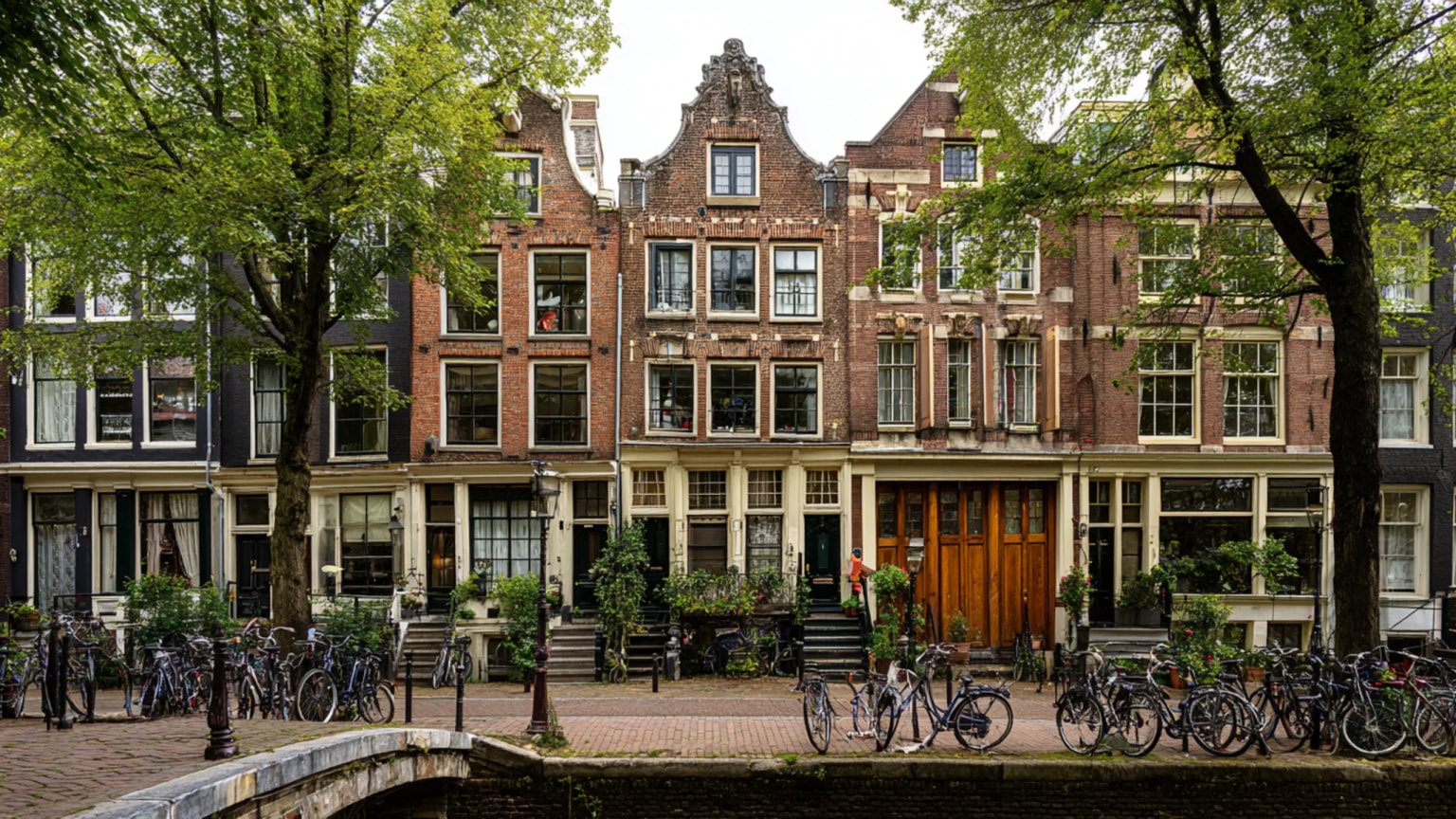
The bicycles tilt over the bridges as if motion were the city's natural state. Water catches the light before the offices do. A child rides ahead of a parent without the scene feeling heroic. The brick facades hold their line. The errands are close. The street is legible. There are richer cities, louder cities, more theatrical cities. Very few make ordinary urban movement feel this sane.
And yet the pressure is now visible almost everywhere that the postcards tell you not to look. The ease of the city has become expensive to enter. The center can feel less inhabited than processed. Amsterdam still performs daily life with uncommon grace; it simply no longer distributes that grace as widely as its reputation suggests.
⸻
1. The verdict in one sentence
Amsterdam still offers one of Europe's great everyday urban experiences, but housing scarcity and visitor pressure now bite too deeply to ignore.
⸻
2. Scorecard
| Criterion | Score |
|---|---|
| Daily life and human scale | 12.5 / 14 |
| Housing dignity and social access | 8.5 / 14 |
| Climate resilience and ecological intelligence | 10.5 / 13 |
| Health, safety and social floor | 10.5 / 12 |
| Civic competence and institutional trust | 8 / 10 |
| Work, learning and economic openness | 7.5 / 9 |
| Culture, street life and everyday pleasure | 8 / 9 |
| Beauty, memory and urban form | 7.5 / 8 |
| Freedom, pluralism and belonging | 6.5 / 7 |
| Global usefulness without self-destruction | 3 / 4 |
Raw score: 82.5 / 100
Shadow penalties applied
Housing extraction: -4— Scarcity and asset pressure have made central urban belonging far too dependent on wealth or queue position.Tourism hollowing: -2— Visitor concentration still distorts central neighborhoods even after stricter management efforts.
Adjusted score: 76.5 / 100
Rank: 10 / 36
Label: Beautiful but Extracted
The numbers tell a clear story. Amsterdam is not being punished for failure at the level of the street. It is being marked down because the city's success has become extractive.
⸻
3. Best for
Amsterdam is best for walkers who prefer not to think about driving, cyclists who want the bicycle to be infrastructure rather than identity, queer public life that does not need to announce itself every five minutes, and people whose idea of urban luxury is not spectacle but frictionless daily routine. It suits couples, families with one child, students with stamina, and migrants who want a city that can be read quickly and inhabited deeply.
It is less kind to anyone who needs cheap entry, generous space, or a low-drama housing search. A city can be tolerant in manners and exclusionary in property; Amsterdam now qualifies on both counts.
⸻
4. The city's genius
Amsterdam's genius is that it turns human scale into a system rather than an aesthetic.
Plenty of cities have a beautiful district or two. Plenty have cycling scenes. Plenty have a canal quarter that tourists confuse with the whole metropolis. Amsterdam's deeper accomplishment is that mixed neighborhoods, low-car daily life, transit, cycling, and a remarkably coherent urban form reinforce one another. The dataset gives it 12.5 out of 14 for daily life for good reason: the city makes the ordinary compact without making it joyless.
That matters more than urbanists sometimes admit. A city is not humane because it has pretty housing stock; it is humane because a Tuesday can be done without defensive logistics. Groceries, schools, tram stops, cafés, parks, libraries, and work feel spatially related. Time is returned to the resident in increments so small that politicians rarely notice them and citizens build their lives out of them anyway.
The secondary genius is moral rather than spatial. Amsterdam still scores 6.5 out of 7 on freedom, pluralism, and belonging because the city continues to allow multiple ways of being adult. It is migrant-shaped, queer-visible, tolerant of informal difference, and relatively uninterested in forcing everyone into one social script. That permissiveness is not decorative. It is one of the reasons the city remains culturally alive rather than merely well-managed.
And beauty here is not a premium layer added to functionality. The 7.5 out of 8 for beauty and urban form comes from coherence: canals, brick terraces, bridges, and legibility assembled into a city you can understand with your body before you finish understanding it with your map. The prestige lists praise Amsterdam as if charm were the point. Our model is stricter. Charm matters because it supports a lived civic intelligence.
⸻
5. The city's wound
The wound is housing first, tourism second, and the two are no longer separable.
An 8.5 out of 14 for housing is not a collapse; it is something more frustrating. The city still retains parts of the social-democratic shelter framework that many richer peers demolished long ago. But severe price pressure, long waits, and thin access for younger households mean that the formal virtues of the housing system no longer produce broad ease. If Vienna shows what housing as public promise looks like, Amsterdam increasingly shows what happens when a good structure is trapped inside scarcity.
Then the penalty bites: minus 4 for housing extraction. That is not a stylistic flourish. It is the editorial name for a concrete civic fact. In too much of Amsterdam, especially in and near the center, belonging depends either on prior access, unusual income, luck, or years spent in a queue. A city that works beautifully for the established resident can still be unjust at the point of entry.
Tourism is the softer wound in the data and the louder one in daily perception. The city loses another 2 points for tourism hollowing because parts of the center still operate as visitor territory first and neighborhood second. Amsterdam has tried to manage this more seriously than many peers, and one can reasonably argue that our tourism penalty is almost harsher on mood than on system. But that is precisely the point of the shadow penalty: to name the distortion that averages hide. A canal city is not fully itself if too much of its center is optimized for temporary consumption.
⸻
6. Neighbourhood test
If we were choosing a life rather than a weekend, we would look first at Oost, De Pijp, and parts of Oud-West and De Baarsjes.
Oost has the virtue that matters most in Amsterdam now: it still feels inhabited rather than curated. The streets have enough daily commerce, enough schools, enough parks, enough cycling ease, and enough ordinary mixed life to show the city's genius without forcing you into its museum register. De Pijp remains denser, busier, more overheated by its own popularity, but it still demonstrates how Amsterdam can hold cafés, markets, transit, and domestic life in a single frame. Oud-West and De Baarsjes offer a similar lesson with a touch more breathing room.
For walking, reading, and public pleasure, one still gravitates toward the canal belt, Jordaan, and the older inner-city districts. For raising a child, we would rather live one or two turns outward, where the city remains more resident than performance. That may sound like a modest distinction. In Amsterdam in 2026 it is the whole distinction.
There is also a fairness note to make here. Our score may be slightly too generous if one judges the city entirely by the entry conditions facing younger outsiders, and slightly too harsh if one judges it by the lived quality of established neighborhoods that still function exceptionally well. Both things are true. That tension is exactly why Amsterdam lands where it does.
⸻
7. 2035 trajectory
The trajectory is bifurcating.
Amsterdam has too much institutional competence to slide easily into chaos. Its 8 out of 10 for governance is not sentimental. The city still knows how to plan, manage water, maintain transit-oriented urbanism, and preserve a coherent public realm. Its 10.5 out of 13 for climate resilience and ecological intelligence also matters: low-carbon mobility, compact form, and serious water management are real strengths, not brochure copy.
But the next decade will sharpen the split between the Amsterdam that works sublimely for those who are already in and the Amsterdam that becomes harder to join. If housing supply, access, and social entry do not improve materially, the city may remain beautiful while growing narrower. If visitor concentration keeps central neighborhoods semi-performative, the city will risk becoming more legible to outsiders than to residents.
Still, Amsterdam is not doomed to caricature. One could imagine a more hopeful 2035 in which the city uses its governance capacity to widen access and protect neighborhood life without losing openness. The reason our verdict stays admiring is that the underlying habitat is strong. The reason the label is Beautiful but Extracted is that strength is being monetized faster than it is being renewed.
⸻
8. Final line
Amsterdam is a bicycle crossing a stone bridge at dusk: graceful, balanced, and just a little too expensive to belong to everyone who should have a right to ride it.
Continue Reading

The View from Below: How London Mistook Skyscrapers for Density
London spent twenty years building upward in the name of the compact city. From the pavements of Shoreditch the arithmetic looks different: the tower privatises the panorama and socialises the silhouette.
The Los Angeles That Almost Learned to Walk
In 1930, a regional parks plan and an electric rail network could have made Los Angeles a polycentric, walkable, tram-linked metropolis. The city commissioned the plan, then put it in a drawer. This is the anatomy of a choice, not a fate.

The Living City Review 2026: A Human-Scale Ranking of the World's Great Cities
Not the best city, the happiest city, or the most powerful city — but the one where a full life is possible. The Living City Review scores 36 great cities on ten criteria of daily life, then subtracts the shadows: housing extraction, car-dependence, inequality, climate negligence.