The Calm Machine: Copenhagen and the Living City Review
Copenhagen turns dignity into routine. The harder question is whether rising housing pressure will thin that achievement from within.

Key Insights
Essential takeaways from this chronicle
Copenhagen places 2nd with an adjusted score of 86.0 and the label Gold Habitat, proving that climate intelligence and daily bodily dignity can be normal urban practice rather than boutique policy.
Point 1 of 4Daily life scores 13 out of 14 and ecology 11.5 out of 13, among the strongest pairings in the whole ranking.
Point 2 of 4The city is penalized only 1.5 points for housing extraction, a warning that rising ownership costs and capital pressure are starting to narrow access for younger and lower-income residents.
Point 3 of 4Governance at 9 out of 10 and health at 11 out of 12 show a city whose public systems are still legible, maintained and built around everyday use.
Point 4 of 4
The Calm Machine: Copenhagen and the Living City Review
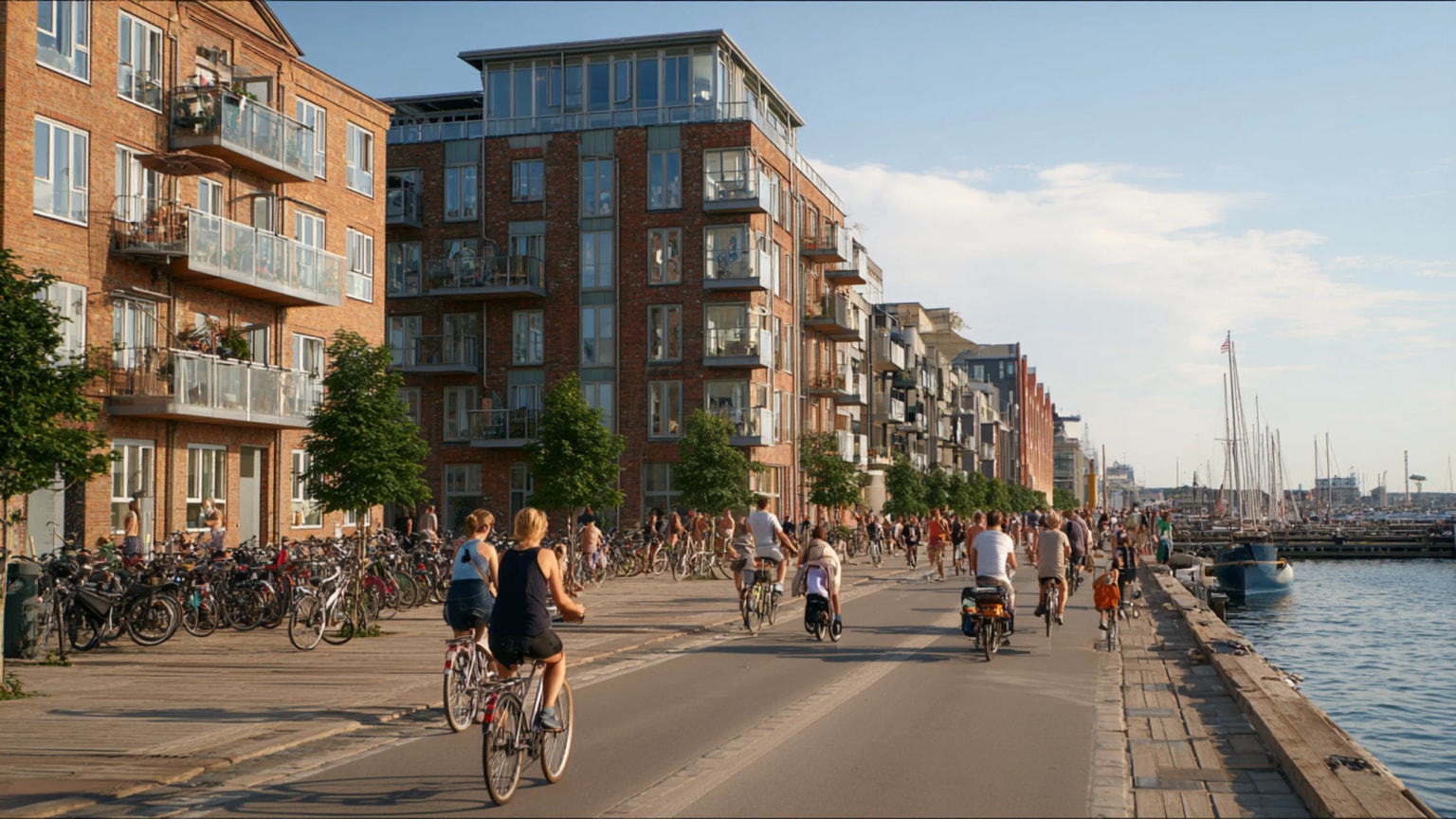
Bicycles slide over bridges with the quiet authority of an argument already won. Harbor water, once an industrial backside, now behaves like public room. The blocks do not strain to impress. They simply know their measure. It is one of the few cities where urban competence feels not merely administrative but almost moral: an insistence that streets should not punish movement, that climate policy should reach the pavement, that daily life deserves design attention usually reserved for monuments.
⸻
1. The verdict in one sentence
Copenhagen is still one of the clearest proofs that a great city can place ordinary life, climate intelligence, and bodily dignity at the center.
⸻
2. Scorecard
| Criterion | Score |
|---|---|
| Daily life and human scale | 13 / 14 |
| Housing dignity and social access | 10.5 / 14 |
| Climate resilience and ecological intelligence | 11.5 / 13 |
| Health, safety and social floor | 11 / 12 |
| Civic competence and institutional trust | 9 / 10 |
| Work, learning and economic openness | 7.5 / 9 |
| Culture, street life and everyday pleasure | 8 / 9 |
| Beauty, memory and urban form | 7.5 / 8 |
| Freedom, pluralism and belonging | 6.5 / 7 |
| Global usefulness without self-destruction | 3 / 4 |
- Raw score:
87.5 / 100 - Shadow penalties:
Housing extraction: -1.5Rising ownership costs and capital pressure are starting to narrow effortless access for younger and lower-income residents.
- Adjusted score:
86.0 / 100 - Rank:
2 / 36 - Label:
Gold Habitat
⸻
3. Best for
Copenhagen is best for cyclists, parents of small children, urbanists who care about the body more than the skyline, swimmers who want a harbor that behaves like common property, and professionals who want a rich public realm without performing affluence. It is also strong for women moving alone, for queer public life, for elderly residents who need the city to stay readable, and for those who believe climate adaptation should feel concrete before it feels visionary.
⸻
4. The city's genius
Its genius is the conversion of restraint into abundance.
Copenhagen is not abundant in the classical metropolitan way. It does not seduce by overwhelming scale, imperial layers or nonstop spectacle. Its abundance is made from friction removed. The dataset basis notes capture this exactly: very high cycling, reliable rail and metro, calm street design and strong car-free access to daily needs make the weekday unusually smooth; blue-green infrastructure, harbor clean-up and low-carbon mobility give the city unusual future-facing competence; public systems remain legible and maintenance is serious.
That is why the daily life score climbs to 13, ecology to 11.5, governance to 9, health to 11 and freedom to 6.5. The city turns what many governments describe as aspirations into visible default conditions. Safe cycling is not a pilot. Clean water is not branding. Shade, harbor edges and mobility are stitched into the ordinary route between home, school, station and shop.
That is why the city ranks so high in our system even without classical metropolitan grandeur. We are not rewarding spectacle. We are rewarding a place where the body is not treated as collateral damage by transport engineering, housing policy or climate negligence. Copenhagen's great urban luxury is not excess. It is the near-absence of needless friction.
Even its beauty is part of this restraint. Harbor fronts, brick streets, human-scale blocks and disciplined public space make ordinary movement feel composed. Copenhagen rarely shouts. It simply reduces the number of small urban humiliations a resident must absorb before lunch.
⸻
5. The city's wound
Housing is the wound, and it matters precisely because the rest works so well.
The city's only penalty is small by international standards: minus 1.5 for housing extraction. But that modest subtraction is not cosmetic. It names the pressure point likely to decide whether Copenhagen remains a habitat for broad ordinary life or becomes a beautiful machine increasingly reserved for the already-secure. The housing basis note is frank: it is expensive, and the social floor still helps, but costs are pinching.
This matters because Copenhagen's model depends on inclusion. A cycling city is less morally interesting if only the salaried upper middle class can live close enough to use it fully. Climate intelligence becomes thinner too if the burden of distance is exported outward. The city still deserves 10.5 for housing because co-ops, non-market stock and tenant security preserve more access than in many peer capitals. Yet the direction of travel is unmistakable.
If our model is a little generous anywhere, it may be here. A mild penalty may understate how quickly a city of this kind can tip from humane to merely admirable once entry costs harden.
⸻
6. Neighbourhood test
We would look first to Østerbro, Nørrebro, Christianshavn and parts of Frederiksberg.
Østerbro is where Copenhagen's family promise becomes legible: calm streets, parks, daily services, bikes everywhere, a public realm that does not treat children as edge cases. Nørrebro remains the better test of pluralism and lived energy, a district where the city's tolerance must prove itself beyond postcard order. Christianshavn offers water, density and a fine-grained urban rhythm, though parts of it already carry the pressure of desirability too visibly. Frederiksberg, though formally its own municipality, belongs to the lived city and shows how green calm, housing quality and urban completeness can align.
Where would we walk? Along the lakes, through Nørrebro, over the bridges into the inner harbor. Where would we read? Østerbro or Frederiksberg. Where would we raise a child? Østerbro first. Where would we test whether Copenhagen is too well-behaved for its own good? Nørrebro, because a living city must allow not only safety but texture.
And where would we test its climate intelligence? Simply on an ordinary wet day, when the harbor edge, bike lane and pavement still make practical sense.
One honest aside belongs here: our 8 for culture may even be a little low if one values pleasure integrated into daily life rather than metropolitan drama. The city's third places, design culture and waterfront sociability are richer than skeptics allow.
⸻
7. 2035 trajectory
Improving, if housing stays political rather than cosmetic.
Copenhagen has unusually strong future equipment. It already knows how to build blue-green infrastructure, protect the body in public space, maintain trust and embed low-carbon mobility in the everyday city. Those are not small advantages in an era of heat, flooding and democratic fatigue. The likeliest reason for slippage is not transport, climate or competence. It is access.
If housing costs keep climbing and the younger middle is pushed outward, the city will gradually lose the social width that makes its design ethic defensible. A well-run capital can become a boutique capital surprisingly quickly. But if Copenhagen expands non-market access, keeps family life close to transit and refuses to sell its public realm to prestige, it could remain Europe's clearest example of how ecological intelligence becomes human dignity.
The machine is sound. The question is whether enough kinds of people will still be permitted to live inside it.
⸻
8. Final line
Copenhagen is a bicycle crossing a clean harbor under a sky that suggests the city has remembered the body in all its plans.
Continue Reading

The View from Below: How London Mistook Skyscrapers for Density
London spent twenty years building upward in the name of the compact city. From the pavements of Shoreditch the arithmetic looks different: the tower privatises the panorama and socialises the silhouette.
The Los Angeles That Almost Learned to Walk
In 1930, a regional parks plan and an electric rail network could have made Los Angeles a polycentric, walkable, tram-linked metropolis. The city commissioned the plan, then put it in a drawer. This is the anatomy of a choice, not a fate.
Canals Under Pressure: Amsterdam and the Living City Review
Amsterdam ranks 10th in The Living City Review 2026 with an adjusted score of 76.5. It remains one of Europe’s finest cities for daily life, but housing scarcity and tourism pressure have turned beauty into a harder civic bargain.