The Climate-Controlled Mirage: Dubai and the Living City Review
A city can move capital brilliantly and still fail ordinary life. Dubai is the sharpest proof in this series.

Key Insights
Essential takeaways from this chronicle
Dubai ranks 36th of 36 with an adjusted score of 29.0 and the label Myth Over Life: efficient in throughput, weak as a broadly shareable urban habitat.
Point 1 of 4Economy scores 8 out of 9 and global usefulness 4 out of 4, confirming the city’s real strengths in trade, logistics, aviation, finance, and regional connectivity.
Point 2 of 4Freedom falls to 2 out of 7, and the city takes a -6 safety-exclusion penalty because migrant laborers, dissidents, and queer residents do not share the same civic protections as affluent professionals and visitors.
Point 3 of 4Additional penalties for housing extraction (-6), climate negligence (-5), car dependency (-5), and inequality shadow (-5) reveal how far the myth outruns the lived city.
Point 4 of 4
The Climate-Controlled Mirage: Dubai and the Living City Review
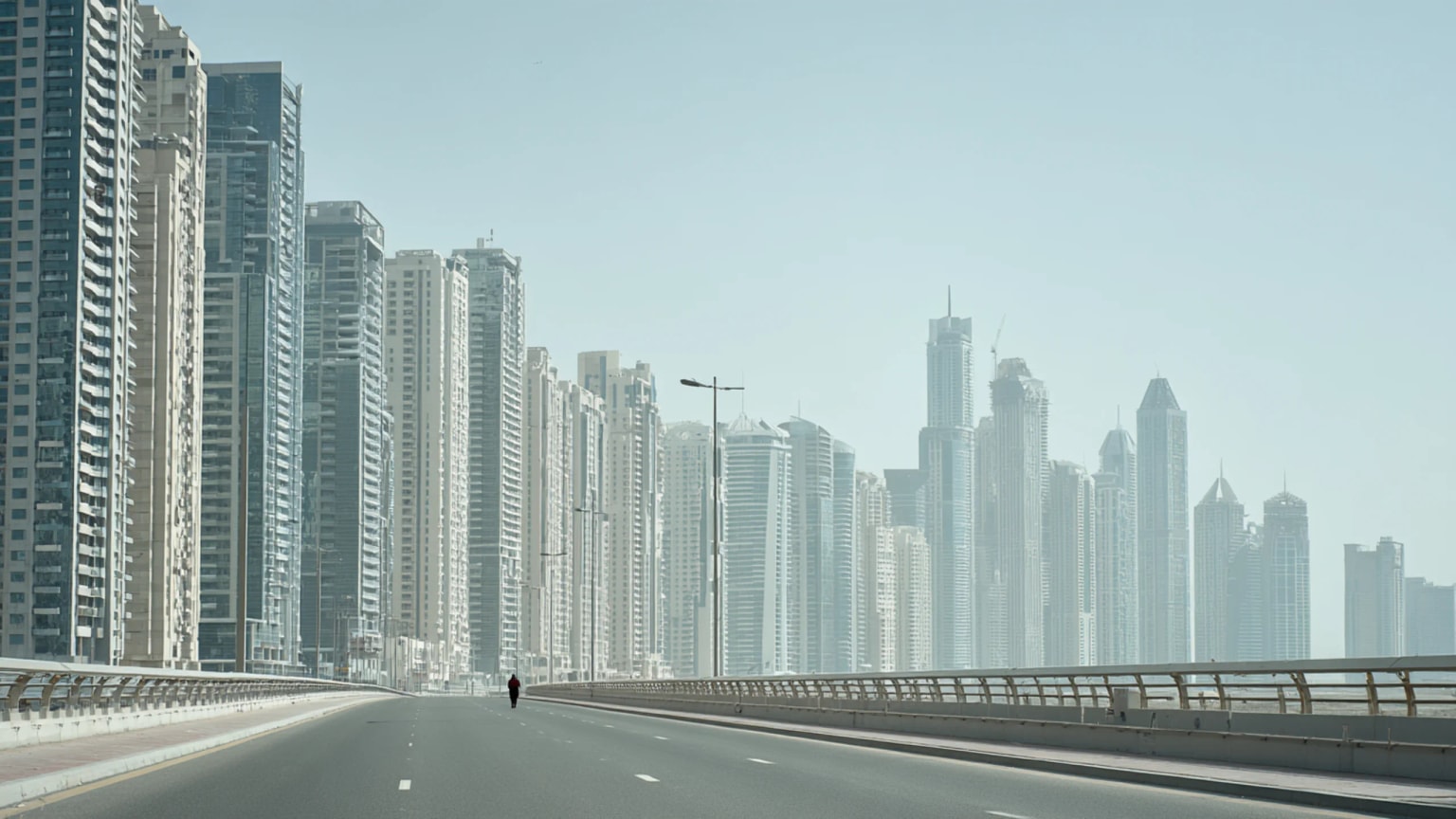
From a distance it looks like the future solved by procurement: towers precisely lit, highways polished, terminals efficient, logistics synchronized, ambition made visible in glass and controlled temperature. It does something many old cities cannot do anymore. It projects competence instantly. Visitors, investors, and prestige rankings are highly susceptible to this kind of clarity.
But a city is not a synchronization diagram. The Living City Review measures habitat, not throughput. It asks whether a serious, ordinary resident can build a rich daily life without being absorbed into systems of heat avoidance, labor hierarchy, road geometry, and managed consent. On that question Dubai performs far worse than its myth.
⸻
1. The verdict in one sentence
Dubai is globally useful and locally efficient, but it still treats too much of urban life as managed consumption built on exclusion, heat, and the car.
⸻
2. Scorecard
| Criterion | Score |
|---|---|
| Daily life and human scale | 7 / 14 |
| Housing dignity and social access | 5 / 14 |
| Climate resilience and ecological intelligence | 4.5 / 13 |
| Health, safety and social floor | 8 / 12 |
| Civic competence and institutional trust | 6.5 / 10 |
| Work, learning and economic openness | 8 / 9 |
| Culture, street life and everyday pleasure | 6 / 9 |
| Beauty, memory and urban form | 5 / 8 |
| Freedom, pluralism and belonging | 2 / 7 |
| Global usefulness without self-destruction | 4 / 4 |
Raw score: 56 / 100
Shadow penalties applied
Housing extraction: -6— Housing operates heavily as an investment and labor-control system rather than a stable civic right.Climate negligence: -5— Extreme heat is managed mainly through energy-intensive enclosure rather than a broadly livable outdoor habitat.Car dependency: -5— Too much ordinary adult life still assumes driving or paid chauffeured movement across wide-road superblocks.Safety exclusion: -6— Migrant laborers, dissidents, and queer residents do not enjoy the same rights, protections, or public freedom as affluent professionals and visitors.Inequality shadow: -5— Headline prosperity masks a steeply stratified city of radically unequal work, housing, and legal security.
Adjusted score: 29 / 100
Rank: 36 / 36
Label: Myth Over Life
This is the lowest-ranked city in the table not because it lacks power, wealth, or organization, but because those strengths are not arranged around broad urban dignity.
⸻
3. Best for
Dubai is best for internationally mobile professionals seeking access to regional markets, tax advantages, efficient services, polished event infrastructure, and a city that is easy to transact with if you fit its preferred profile. It also serves those who want aviation connectivity, business convenience, and a controlled version of cosmopolitan life.
It is much worse for anyone who wants democratic public life, deep neighborhood texture, outdoor ease through most of the year, labor equality, or a city that treats residence as citizenship rather than stratified permission. It is not that nobody lives well in Dubai. It is that the good life is too selectively distributed and too mechanically staged.
⸻
4. The city's genius
Dubai's genius is infrastructural coordination in the service of global usefulness.
An 8 out of 9 for economy and a 4 out of 4 for global usefulness are not accidents. Trade, logistics, aviation, finance, tourism, and regional professional services give the city real economic depth. Unlike some pure prestige projects, Dubai is not merely decorative. It is a functioning hinge between regions, capital pools, and migrant labor systems. It is useful in the literal sense of moving things, people, and deals.
The city also deserves some credit for civic competence, hence the 6.5 out of 10. Infrastructure gets built. Public order is legible. Services for those inside the preferred bands of access are often efficient. In a world of decaying metropolitan states, that kind of delivery can look intoxicating.
It helps explain why the city is so often misread. People confuse the speed of implementation with the quality of urban life. They see the metro, the airport, the skyline, the cleanliness, the service economy, and assume the habitat underneath must be strong. But execution is not the same as belonging, and movement is not the same as public freedom.
Even the city's weaker scores reveal part of its method. A 6 for culture and everyday pleasure is not a dismissal. Dubai does offer impressive food, events, and a multinational social scene. The problem is that much of this life is venue-mediated, mall-mediated, or hospitality-mediated. It is culture offered as access package rather than accumulated neighborhood texture.
⸻
5. The city's wound
Dubai's wound is that it has built a global city without fully building a civic city.
Start with freedom: 2 out of 7. That number is not rhetorical. Speech, labor organizing, queer visibility, and informal dissent remain sharply constrained. The city can feel cosmopolitan on the surface while remaining narrow in the distribution of rights. That is why the safety-exclusion penalty is a severe minus 6. A city where different classes and identities do not enjoy the same public freedom is not merely imperfect. It is structurally unequal in a way that reaches the moral core of habitat.
The climate score, 4.5 out of 13, is another decisive weakness. Extreme heat, desalination dependence, energy-intensive cooling, and limited everyday nature mean the city manages the environment largely by sealing itself against it. That is why the climate-negligence penalty is minus 5. The issue is not that Dubai is hot. Many important cities are hot. The issue is that heat is answered too often by indoor enclosure rather than by building a broadly livable outdoor city.
Then there is car dependency, another minus 5. The metro matters, and some districts function better than lazy critics admit. But too much ordinary life still depends on arterial roads, wide superblocks, long transfers, parking logic, or paid movement. A city can be photogenic from the elevated line and still be punishing at ground level.
Housing receives 5 out of 14 and then a minus 6 housing-extraction penalty because abundant new supply does not equal dignity. When housing is expensive, insecure, and deeply tied to employer and visa status for many residents, the civic meaning of shelter remains weak. Add the inequality-shadow penalty of minus 5 and the structure becomes plain: headline prosperity hides radically different urban conditions by class and legal status.
⸻
6. Neighbourhood test
If we had to choose a life in Dubai, we would look first to the older creek-side and lower-rise districts: Al Fahidi for memory, Bur Dubai and Deira for texture, Al Satwa for everyday street life, and parts of Jumeirah 1 for a more walkable domestic rhythm.
That list is revealing. The districts that feel most like city are the ones least dominated by pure superblock spectacle. Around the creek, one finds some of the density, friction, and mixed routine that global city life usually requires. In Al Satwa and older mixed districts, the street can still feel like a social medium rather than a transport gap between buildings.
Would we raise a child there? Only with qualifications. The answer depends too heavily on income, visa security, schooling access, and the ability to buy your way around the structural weaknesses of the habitat. In that sense Dubai fails our neighborhood test in a particularly sharp manner: the question is not which district is best, but how much private buffering you need before any district becomes convincing.
To be fair, our score may strike some readers as too harsh because it underweights the genuine relief many residents feel in a city that functions efficiently and offers economic mobility unavailable elsewhere in the region. It may also be too generous if one judges the city by equal civic standing rather than selective professional convenience. That tension is why Dubai ends where it does.
⸻
7. 2035 trajectory
The trajectory is fragile.
Dubai will almost certainly remain rich, connected, and useful in 2035. The question is whether it can become more livable in the older and deeper urban sense. That would require turning climate adaptation outward rather than inward, making walking and neighborhood life structurally easier, widening rights and resident voice, and reducing the dependence of everyday life on labor stratification and managed enclosure.
None of that is impossible. But none of it follows automatically from more towers, more cooled interiors, or more event infrastructure. The city already knows how to build fast. It has not yet shown that it wants to build a broadly shareable civic life.
This is why Dubai is the clearest foil in the series. Many rankings reward it for precisely the things our model treats as secondary: efficiency, spectacle, connectivity, capital throughput. We do not deny those strengths. We deny that they answer the only question that finally matters: can ordinary residents inhabit the city as a full public life rather than a managed service environment?
⸻
8. Final line
Dubai is an air-conditioned boulevard through desert heat: dazzling in motion, tightly controlled, and still too dependent on sealed interiors to feel fully alive in the open.
Continue Reading
The View from Below: How London Mistook Skyscrapers for Density
London spent twenty years building upward in the name of the compact city. From the pavements of Shoreditch the arithmetic looks different: the tower privatises the panorama and socialises the silhouette.
The Los Angeles That Almost Learned to Walk
In 1930, a regional parks plan and an electric rail network could have made Los Angeles a polycentric, walkable, tram-linked metropolis. The city commissioned the plan, then put it in a drawer. This is the anatomy of a choice, not a fate.
Canals Under Pressure: Amsterdam and the Living City Review
Amsterdam ranks 10th in The Living City Review 2026 with an adjusted score of 76.5. It remains one of Europe’s finest cities for daily life, but housing scarcity and tourism pressure have turned beauty into a harder civic bargain.