The City That Climbed Back: Medellín and the Living City Review
Medellín has earned its hope honestly. The city’s social urbanism changed the terms of life, not enough yet to make the valley equal.

Key Insights
Essential takeaways from this chronicle
Medellin ranks 24th of 36 with an adjusted score of 59.0 and the label Rising Living City: one of the strongest cases of real urban improvement in the series, still marked by deep structural gaps.
Point 1 of 4Culture scores 8 out of 9 and beauty 7 out of 8, reflecting a city whose neighborhood identity, mountain setting, and civic imagination remain vivid beyond elite enclaves.
Point 2 of 4The city loses -5 for inequality shadow because headline progress still conceals steep differences between better-served central zones and poorer hillside districts.
Point 3 of 4A further -3 safety-exclusion penalty shows that not everyone moves through Medellin with the same ease, despite the city’s genuine gains.
Point 4 of 4
The City That Climbed Back: Medellín and the Living City Review
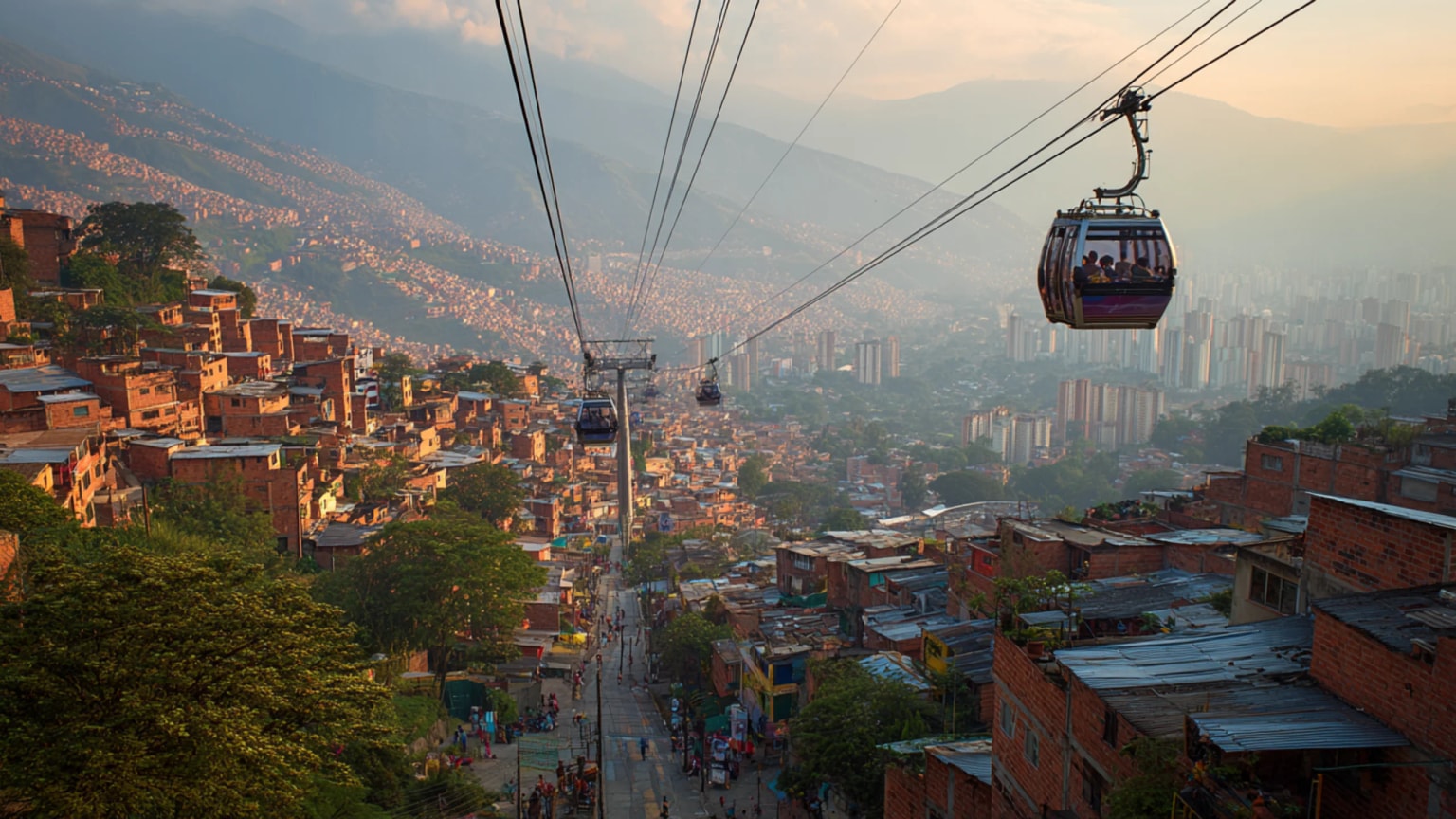
In Medellín the valley itself tells the story. The dense floor, the climbing neighborhoods, the cable lines crossing the hills, the abrupt transitions between civic optimism and old exclusion: all of it reads as urban form, but also as memory. This is a city the world once reduced to violence and then, with suspicious speed, promoted to redemption story. Both versions were too simple.
Medellín deserves better than myth in either direction. It is one of the most important cities in this series because it proves that urban governance can change the texture of life. It also proves that improvement is not the same thing as completion. Medellín has imagination. It has earned its hope. It has not yet abolished the geography of inequality.
⸻
1. The verdict in one sentence
Medellín is one of the world's clearest cases of urban improvement with genuine civic imagination, but it has not yet dissolved the inequalities that shape everyday life.
⸻
2. Scorecard
| Criterion | Score |
|---|---|
| Daily life and human scale | 9 / 14 |
| Housing dignity and social access | 8 / 14 |
| Climate resilience and ecological intelligence | 8 / 13 |
| Health, safety and social floor | 7 / 12 |
| Civic competence and institutional trust | 7 / 10 |
| Work, learning and economic openness | 6 / 9 |
| Culture, street life and everyday pleasure | 8 / 9 |
| Beauty, memory and urban form | 7 / 8 |
| Freedom, pluralism and belonging | 5 / 7 |
| Global usefulness without self-destruction | 2 / 4 |
Raw score: 67 / 100
Shadow penalties applied
Inequality shadow: -5— Strong headline improvements still mask steep gaps between well-served central zones and poorer hillside districts.Safety exclusion: -3— Some groups still experience parts of the city as constrained by crime risk, policing patterns or territorial control.
Adjusted score: 59 / 100
Rank: 24 / 36
Label: Rising Living City
This is a score that admires change without pretending change has solved everything.
⸻
3. Best for
Medellín is best for urbanists who care about public transport as social policy, for residents who value neighborhood identity over polished prestige, for people drawn to strong street life, mountain geography, and civic experimentation, and for anyone who wants to see a city where public works have genuinely altered possibility.
It is less suited to those who need high institutional predictability, fully even safety, or the assurance that civic gains are already universal. Medellín asks for realism. It offers more daily vitality than many richer cities, and less social security than its admirers sometimes admit.
⸻
4. The city's genius
Medellín's genius is social urbanism made visible in daily movement.
The metro, the Metrocable, the civic escalators, the libraries, the neighborhood-scale public interventions: together they form one of the clearest demonstrations in the modern city that infrastructure can be moral. Our launch essay insists that cities are habitats rather than platforms. Medellin is persuasive because it tried, more than most, to use transport and public space to widen habitat rather than merely accelerate capital.
That is why a 9 out of 14 for daily life matters more here than it might in a flatter or wealthier city. In a steep valley with dense districts and long histories of inequality, making routines more car-light is not just convenience. It is a redistribution of access. The city's transit-led structure does not erase the hills, the traffic, or the friction of walking; the basis notes are candid about that. But it does create a daily urban logic more humane than the city's topography alone would predict.
Culture is another serious strength. The 8 out of 9 for culture, street life, and everyday pleasure is earned through music, libraries, neighborhood identity, and public sociability that extends beyond elite consumption. Medellin still feels locally itself. That distinction matters in a region where some fast-growing cities have become generic before they became fair.
The beauty score of 7 out of 8 is also more than scenic generosity. The bowl of mountains, brick hillsides, and civic infrastructure cut into dramatic terrain produce an urban image that is memorable because it is lived. Beauty here is not the refined finish of a wealthy capital. It is a charged relation between geography and human persistence.
⸻
5. The city's wound
The wound is that improvement has been real without becoming equal.
Medellín's raw score of 67 is respectable, but the penalties are what make the city morally legible. Minus 5 for inequality shadow is the central fact. Headline transformation still masks steep gaps between better-served central zones and poorer hillside districts. A city can build admired infrastructure, green corridors, and civic landmarks and still leave enormous differences in housing quality, service access, exposure, and opportunity.
Housing, at 8 out of 14, captures this mixed condition well. Medellin remains more attainable than North American and Western European star cities, yet informal settlement, tourist pressure in some central areas, and unequal housing quality constrain dignity. This is not a city flattened by property speculation alone. Its housing story is more layered, which is why the wound reads spatially as much as financially.
Safety is the second shadow. The city scores 7 out of 12 on health, safety, and social floor, then loses another 3 points for safety exclusion. Violence is far below its worst era; to pretend otherwise would be lazy and unfair. But not everyone moves through Medellin with the same ease. Crime risk, territorial control, and uneven policing still shape the lived map. A resident's freedom is still partly determined by where they are and who they are.
This is also why Medellin's 5 out of 7 for freedom and belonging is not higher. Plural life exists. Creativity exists. Public life exists. But class geography remains powerful. The city has improved more convincingly than many cities that score above it on reputation. It has not yet made itself loose enough, safe enough, or equal enough to move fully into the top tier.
⸻
6. Neighbourhood test
If we were choosing a life in Medellín, we would begin with Laureles-Estadio, Carlos E. Restrepo, Belen, and selected parts of El Poblado only where neighborhood life still outruns the visitor economy.
Laureles-Estadio offers one of the city's most convincing combinations of walkability, trees, transit access, cafés, schools, and everyday neighborhood balance. Carlos E. Restrepo remains one of the finer answers to the question of whether a district can be intellectually calm without becoming sterile. Belen provides another version of lived Medellín: less mythologized, more domestic, more useful. El Poblado contains comfort and energy, but also too much of the tourist-facing, price-pressured version of the city to be our first answer.
Where would we walk, read, and raise a child? Somewhere west of the most performative narratives and close to transit, shade, and ordinary commerce. The right neighborhood in Medellín should make you feel the city's civic ambition, not only its consumption economy.
There is an honest caveat to add. Our score may be too generous if one judges the city by the persisting severity of district-level inequality and the unevenness of safety. It may be too harsh if one judges it as a city in motion rather than as a completed habitat. Since this series cares about both condition and trajectory, Medellin receives credit for real public imagination and no exemption from its unfinished work.
⸻
7. 2035 trajectory
The trajectory is improving, though not serenely.
Medellín's ecology score of 8 points toward one real avenue of hope. The Green Corridors mattered. Proximity to mountain nature matters. The city has shown that climate-sensitive retrofits can change the felt environment, not just a policy spreadsheet. Its governance score of 7 also reflects something many richer cities have lost: the ability to produce visible, legible urban projects that ordinary residents can actually notice.
But improvement here should not be romanticized into inevitability. Continuity of policy, fiscal discipline, safety gains, and broader upward mobility all remain vulnerable to political drift and structural inequality. The city is not fragile in the way a hollowed prestige metropolis is fragile. It is fragile in the more common urban sense: success has been real, but not yet deep enough to become irreversible.
Medellín matters because it teaches something bigger than itself. Cities can change. Infrastructure can widen dignity. Public space can redistribute hope. Yet none of those achievements substitute for the slower labor of equalizing opportunity across the whole urban field. By 2035 Medellín could become one of the most persuasive rising habitats in the world. It has not earned that title yet. It has earned the right to keep trying.
⸻
8. Final line
Medellín is a cable car crossing a steep green valley: practical, improbable, hopeful, and still suspended over a geography of unequal ground.
Continue Reading
The View from Below: How London Mistook Skyscrapers for Density
London spent twenty years building upward in the name of the compact city. From the pavements of Shoreditch the arithmetic looks different: the tower privatises the panorama and socialises the silhouette.
The Los Angeles That Almost Learned to Walk
In 1930, a regional parks plan and an electric rail network could have made Los Angeles a polycentric, walkable, tram-linked metropolis. The city commissioned the plan, then put it in a drawer. This is the anatomy of a choice, not a fate.
Canals Under Pressure: Amsterdam and the Living City Review
Amsterdam ranks 10th in The Living City Review 2026 with an adjusted score of 76.5. It remains one of Europe’s finest cities for daily life, but housing scarcity and tourism pressure have turned beauty into a harder civic bargain.