Brilliance on a Fault Line: San Francisco and the Living City Review
One of the world’s great urban minds now asks too many ordinary residents to pay for that greatness in instability, street disorder, and exclusion.

Key Insights
Essential takeaways from this chronicle
San Francisco ranks 31st of 36 with an adjusted score of 50.5 and the label Brilliant but Wounded: intellectually unmatched in some domains, civically harsher than its admirers admit.
Point 1 of 4Beauty scores 8 out of 8 and global usefulness 4 out of 4, confirming that the city still matters far beyond its size in technology, higher education, and culture.
Point 2 of 4Housing dignity is only 2 out of 14, then takes the maximum housing-extraction penalty of -8 because shelter has become one of the city’s principal engines of exclusion.
Point 3 of 4Inequality shadow (-5) and governance theatre (-3) explain why a city of such gifts can still land near the bottom third of the table.
Point 4 of 4
Brilliance on a Fault Line: San Francisco and the Living City Review
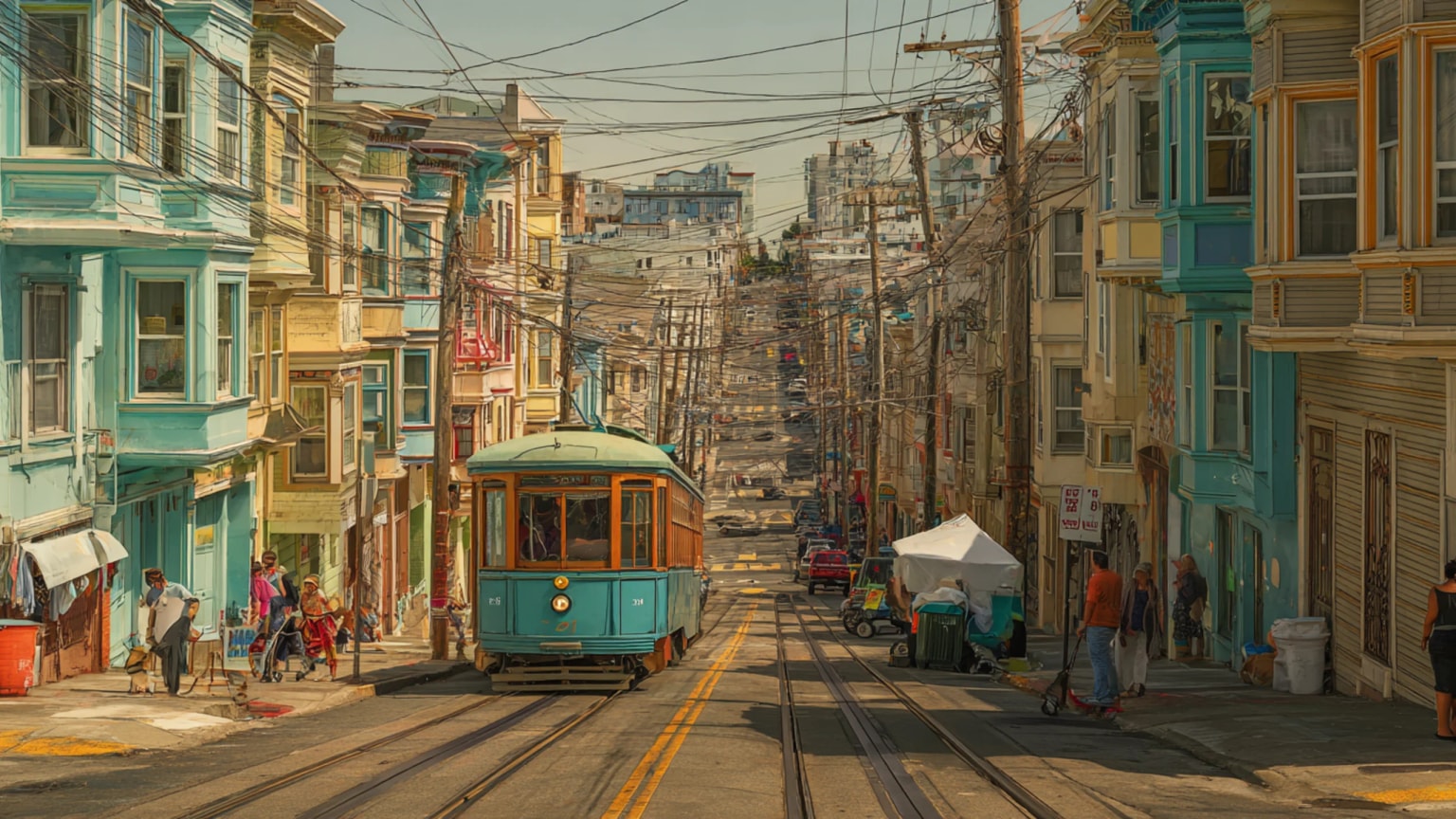
The light off the bay still arrives like revelation. The hills keep making the body aware that geography exists. A cable car may be cliché, but the incline is not. The grid catches the fog. The parks interrupt the real-estate logic just enough to remind you that this place once believed public life could be a form of freedom. San Francisco remains one of the world's great stage sets for urban longing.
But a stage set is not a habitat. Our model is unromantic about this. A city can be visually sublime, culturally alive, economically world-shaping, and still ask ordinary people to live inside a machinery of exclusion. San Francisco's problem is not that it lost its mind. It is that it kept its mind and misplaced too much of its civic competence.
⸻
1. The verdict in one sentence
San Francisco is still one of the world's great urban minds, but its housing regime and governance failures keep turning brilliance into cruelty.
⸻
2. Scorecard
| Criterion | Score |
|---|---|
| Daily life and human scale | 10 / 14 |
| Housing dignity and social access | 2 / 14 |
| Climate resilience and ecological intelligence | 8 / 13 |
| Health, safety and social floor | 7 / 12 |
| Civic competence and institutional trust | 5 / 10 |
| Work, learning and economic openness | 8 / 9 |
| Culture, street life and everyday pleasure | 8 / 9 |
| Beauty, memory and urban form | 8 / 8 |
| Freedom, pluralism and belonging | 6.5 / 7 |
| Global usefulness without self-destruction | 4 / 4 |
Raw score: 66.5 / 100
Shadow penalties applied
Housing extraction: -8— Housing scarcity and speculation have turned shelter into one of the city's central engines of exclusion.Inequality shadow: -5— Extreme wealth and extreme precarity sit side by side, making citywide averages morally misleading.Governance theatre: -3— The city is rich in plans and procedural politics, but too often poor in timely execution.
Adjusted score: 50.5 / 100
Rank: 31 / 36
Label: Brilliant but Wounded
This is one of the clearest cases in the review where the penalties are not garnish. They are the explanation.
⸻
3. Best for
San Francisco is best for founders, researchers, programmers, artists who still feed on oddness, queer history, protest memory, walkers who like hills and weather, and anyone who wants to live near one of the most intellectually generative regional ecosystems on earth. It remains a remarkable city for work and learning if your profession can cash the city's advantages.
It is far worse for families without serious income, public servants, people who need predictable housing costs, and residents who require basic urban systems to function without being narrated as permanent pilot projects. The city gives extraordinary possibility to some and treats others as collateral.
⸻
4. The city's genius
San Francisco's genius is the improbable combination of civic looseness, landscape beauty, and world-changing intellectual density.
The 8 out of 9 for economy and the 4 out of 4 for global usefulness reflect something real: the Bay remains globally unmatched in opening certain kinds of work, learning, and invention. Universities, capital networks, technical labor markets, and adjacent research institutions make the city-region disproportionately consequential. There are larger economies and more efficient business capitals. There are not many places where ideas become institutions at this speed.
Unlike some global command cities, San Francisco does not owe its influence only to corporate might. It still has a genuine civic imagination in its bloodstream. The 6.5 out of 7 for freedom is deserved. Oddness, dissent, queer visibility, protest, and alternative adulthood remain part of the civic DNA. The city has not fully surrendered to respectability, which is one reason people continue to project hope onto it.
Then there is the visual fact: 8 out of 8 for beauty. That is not civic boosterism. The topography, the bay light, the parks, the slant of the streets, the relation between water and grid: these make San Francisco one of the world's unmistakable urban forms. Beauty matters here because it is not confined to one ceremonial axis. It enters daily life. To walk from North Beach into Chinatown, or to watch the afternoon light settle over the Inner Sunset, is to remember that urban form can still reorganize mood.
San Francisco also scores 8 out of 9 for culture because the place remains serious beneath the stereotypes. Its food, music, bookstores, universities, queer history, and political memory all exceed what a city of this size ought to carry. The tragedy is not that the city became shallow. The tragedy is that it remained deep while growing harder to inhabit.
⸻
5. The city's wound
The wound is housing first, and then the governmental style that lets housing failure become normal.
The housing score is 2 out of 14. No elegant sentence can make that less damning. Few major cities in the review show a harsher mismatch between wages, rents, ownership costs, and ordinary social access. This is not the usual complaint about a desirable place being pricey. It is a structural indictment. When a city with this much wealth and this much technical intelligence cannot keep teachers, service workers, artists, and many middle-income families inside it, the issue is political before it is economic.
The maximum housing-extraction penalty, minus 8, is therefore entirely appropriate. Shelter in San Francisco has become a central engine of exclusion. The city does not merely fail to solve its housing problem; the housing problem organizes who gets the city and who gets pushed out of it.
Health and safety tell the same split story. A 7 out of 12 is pulled upward by elite medical institutions and downward by visible homelessness, addiction, mental-health crisis, and unequal street safety. The inequality shadow, minus 5, names the moral offense that tidy averages conceal. Extreme wealth and extreme precarity do not coexist here as an abstract urban condition; they occupy the same blocks.
Then comes governance. A score of 5 out of 10 plus a governance-theatre penalty of minus 3 is devastating in its own understated way. San Francisco can legislate, pilot, debate, and proceduralize almost anything. It too often struggles to deliver basic housing and public-space competence at scale. There are few cities in this series where rhetoric and capacity separate so cleanly.
⸻
6. Neighbourhood test
If we were choosing where to live, walk, and read, we would begin with the Inner Sunset, Bernal Heights, Noe Valley, and selected parts of North Beach and the Mission.
The Inner Sunset still gives something close to an urban daily life rather than a lifestyle brand: useful shops, Golden Gate Park, transit links, family routine, and a measure of calm. Bernal Heights and Noe Valley, though costly, show San Francisco at its most domestically coherent, where neighborhood scale, topography, and everyday commerce line up. North Beach retains literary and café pleasures almost absurdly well. The Mission still carries cultural force, food, and street life, though it also stages the pressure and displacement that define the city's wound.
For raising a child, one gravitates toward the western and southern neighborhoods where the city is less performative and daily routine can still form a pattern. For civic stimulation, one drifts north and east. That very split tells you something. San Francisco's best districts often offer one half of the good city at a time: family life here, public intensity there, affordability almost nowhere.
An honesty note is required. Our score may be too harsh if one thinks the review underestimates how much of San Francisco's social crisis is bound up with regional and national failure, not only municipal failure. It may be too generous if one judges by the simple question our model prioritizes: can ordinary engaged residents still belong? On that question, the city has made itself difficult to forgive.
⸻
7. 2035 trajectory
The trajectory is fragile.
There are reasons not to lapse into fatalism. The ecology score of 8 reflects genuine strengths: a mild climate, strong parks, and serious climate planning. The city still has enormous wealth, human capital, and global attention. It could become more humane relatively quickly if it chose to build shelter, repair public order without cruelty, and treat execution as seriously as discourse.
But fragility is the correct word because San Francisco has spent too long proving that intelligence does not guarantee delivery. Wildfire smoke, sea-level exposure, housing scarcity, regional inequality, and a damaged street-level social floor all interact. The risk is not sudden collapse. The risk is a long continuation of brilliance at the top and cruelty at the bottom, normalized as the price of innovation.
San Francisco is the kind of city many lesser places imitate badly. That makes its failures instructive. If it can relearn civic competence, it could become one of the great urban recoveries of the next decade. If not, it will remain one of the world's most beautiful warnings.
⸻
8. Final line
San Francisco is bay light on a steep street: dazzling, intelligent, free in spirit, and built atop a civic gradient too many residents are forced to slide down.
Continue Reading
The View from Below: How London Mistook Skyscrapers for Density
London spent twenty years building upward in the name of the compact city. From the pavements of Shoreditch the arithmetic looks different: the tower privatises the panorama and socialises the silhouette.
The Los Angeles That Almost Learned to Walk
In 1930, a regional parks plan and an electric rail network could have made Los Angeles a polycentric, walkable, tram-linked metropolis. The city commissioned the plan, then put it in a drawer. This is the anatomy of a choice, not a fate.
Canals Under Pressure: Amsterdam and the Living City Review
Amsterdam ranks 10th in The Living City Review 2026 with an adjusted score of 76.5. It remains one of Europe’s finest cities for daily life, but housing scarcity and tourism pressure have turned beauty into a harder civic bargain.