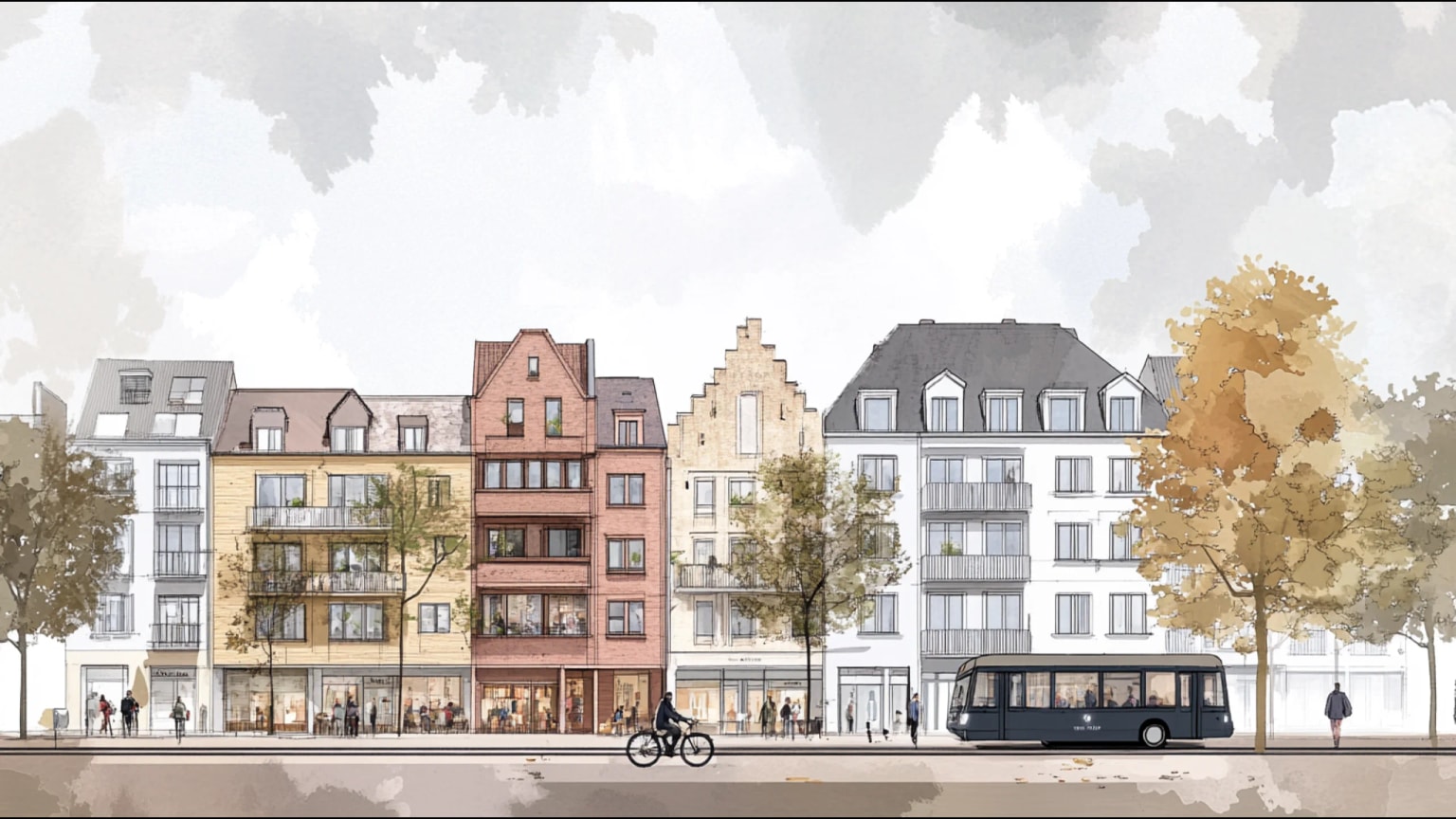
A Popular Building Code for Five-to-Eight-Storey Cities
Hamburg, Freiburg, Copenhagen, Vienna, Barcelona, Bologna – the right-height city is already being built in pieces. What would a unified code look like? A popular essay masquerading as a codebook.

Key Insights
Essential takeaways from this chronicle
Mid-rise perimeter blocks of 5–8 storeys can house 150–350 dwellings per hectare—matching high-rise clusters while delivering better walkability, street life and energy performance.
Pollard Thomas Edwards et al. Superdensity: The Sequel (2015)Greater London Authority. Lessons from Higher Density Development (2012)Point 1 of 5Bologna has required porticoes since 1288, producing 62 km of continuous arcades—a thousand-year proof that cities can legislate ground-floor quality into permanence.
UNESCO World Heritage Nomination: The Porticoes of Bologna (2021)Bologna Welcome. The Porticoes of BolognaPoint 2 of 5Freiburg's Vauban district proves car-light mid-rise is viable: over 70% of households live car-free, with walking, cycling and transit dominating daily trips.
Point 3 of 5Climate-responsive design must be coded by latitude: high-latitude cities need sun pockets and wind breaks; temperate cities need porticoes and deep balconies; tropical cities need cross-ventilation and monsoon choreography.
Mikaeili et al. Climate-Responsive Design Principles in Winter City Urban Public Open Spaces (2025)Chapman, D. Sensitive Urban Design for Winter Settlements (2018)Point 4 of 5Barcelona's Superblocks show you can retrofit an existing mid-rise grid for low-car life without demolition—grouping nine blocks, calming interior streets, reclaiming space for people.
Ajuntament de Barcelona. Let's Fill Streets with Life (2016)Nieuwenhuijsen et al. The Superblock model: A review (2024)Point 5 of 5
The Elbe is just beyond the quay. Trams and buses glide past every few minutes. The buildings around you are mostly five to eight storeys tall: offices over shops, housing above that, with courtyards behind. Children walk to school under street trees. Delivery vans share space with cargo bikes. You could live your whole week here without touching a car.
Now teleport to Freiburg's Vauban. The buildings are similar in height, but the mood is quieter. Many streets are car-free. Most buildings are passive house or close to it. A tram cuts through the middle; over 70% of households don't own a private car.
Fly again, this time to Copenhagen's Nordhavn. You're still at roughly the same scale—five to eight storeys, courtyards, active ground floors—but now the entire district is wired into district heating, district cooling, geothermal energy and what is currently the world's largest seasonal heating storage facility.
These places are not utopia. They are working fragments of a Right-Height City: dense enough to support transit and local shops, low enough to keep streets human, built intelligently for the local climate.
The question is: how do you move from scattered examples to a practical building code for five-to-eight-storey cities—a code that also steals the best of Art Nouveau and Art Deco (portals, ornament as structure, drama at the entrance) and respects sun, rain and latitude?
Let's treat this as a popular essay masquerading as a codebook.
1. Blocks, streets, lives: where the rules actually land
Urbanists have been quietly converging on the same idea for two decades: mid-rise perimeter blocks are the sweet spot between sprawl and towers.
Studies for London's "superdensity" work showed that 5–8 storey perimeter blocks can house 150–350 dwellings per hectare, at densities similar to many high-rise schemes, while performing better for energy and liveability. Paris's Haussmannian quarters, mostly six to seven storeys wrapped around courtyards, sit exactly in this range and still function as some of the most desirable neighbourhoods in the world.
Newer projects imitate this form, consciously or not:
- HafenCity, Hamburg – 157 hectares of former docks, reconceived as a "city within the city" with a fine-grained mix of housing, workplaces, culture and leisure, mostly in mid-rise blocks.
- Aspern Seestadt, Vienna – a former airfield turned into a transit-first lake district for about 25,000 residents and 20,000 jobs, planned around U-Bahn line U2 and mid-rise blocks with strong public space.
- Nordhavn, Copenhagen – a "five-minute city" where almost all basic needs are within a short walk of mid-rise blocks, backed by a district energy system aimed at CO₂-neutral operation.
If you strip away the branding, what these places share is a geometry:
- Blocks mostly 80–150 metres long.
- Buildings mostly 5–8 storeys.
- Ground floors reserved for public life: shops, services, entrances, workshops.
- Courtyards for light, air, and shared space.
- Public transport running through the middle, not around the edges.
Walkability research backs this geometry. Large comparative studies show that block length, intersection density and proximity to destinations are strongly associated with more walking and less car use.
So the first articles of any serious code for the Right-Height City are not about ornament. They're brutally simple:
- Keep blocks small enough to be permeable.
- Pack enough uses into each block that walking makes sense.
- Reserve the spine of the street network for feet, bikes and electric transit.
Everything else—the portals, balconies, porticoes—hangs off that skeleton.
2. Ground floors: portals, porticoes, and why Bologna still matters
Art Nouveau and Art Deco shared an obsession with the ground floor. Entrances were not apologetic gaps; they were portals. Thresholds mattered. Buildings announced themselves.
Bologna wrote that instinct into law centuries ago.
From 1288, the city required new houses to have porticoes, and forced existing houses without them to add them. Over time, this produced about 62 kilometres of continuous arcades—roughly 40 km in the historic centre—recently recognised as a UNESCO World Heritage site.
The effect is profound and everyday:
- You can walk for hours sheltered from rain and summer sun.
- Shops, cafés and workshops spill naturally into the covered walkway.
- The portico itself becomes a social room: a place to talk, wait, eat, play music.
A modern Right-Height Code can be just as explicit:
Rule 1: Every mid-rise block on a main street must have a "thick" ground floor. Minimum 4.5 m floor-to-ceiling, with a sequence of portals—doors, shopfronts, passages, arcades—at least every 25–30 metres.
Hamburg's HafenCity effectively does this: design guidelines require active ground floors on key streets and waterfronts, and most blocks include cafés, shops, or cultural functions at street level. Vienna's Aspern Seestadt front-loads schools, community centres and shops on main axes near the U-Bahn, so that a tram stop usually comes with something to do.
Art Nouveau gives us the shape of the portal: wide, tall, sometimes curved, framed by stone or glazed tiles, often with ironwork that signals "public." Art Deco gives us the rhythm: strong vertical pilasters, recessed entries, elegant signage. Both traditions understood that the first four metres of a building are where the city and the private realm negotiate with each other.
A modern code can absorb this without pastiche:
- Require that at least 60% of a main-street frontage be "active"—transparent shopfronts, entries, lobbies, galleries.
- Ban long stretches of blank wall; service bays and parking ramps must be internalised or pushed to alleys.
- Encourage colonnades or porticoes in climates with heavy rain or strong sun, using Bologna's dimensions (3.5 m high, 2.5 m deep) as a baseline.
The result: you get something that feels like the ground floors of Barcelona's Eixample or Paris's boulevards, but tuned to contemporary uses—a row of bakeries, repair shops, co-working spaces, small factories—rather than a monoculture of fashion chains.
3. Mid-rise in practice: districts that already follow the "code"
It helps to pin down the code by looking at places that already behave as if someone wrote it.
Freiburg Vauban – low cars, high performance
Vauban began as a citizen-driven project on former military land. Today it's a district of row houses and walk-up apartments, mostly 3–5 storeys, at net densities of 90–100 dwellings per hectare. Buildings meet strict low-energy or passive-house standards; many are "plus-energy," generating more electricity than they consume.
The traffic concept is radical but straightforward:
- Most streets are car-free or car-light; residents who own cars park them in collective garages at the edge of the district.
- A tram line and excellent cycling network make it easy to move without a car.
- Over 70% of households live car-free, and mode share for walking, cycling and transit is correspondingly high.
Evaluations of Vauban's mobility behaviour show that people who gave up cars didn't just change mode; they changed habits—more local errands, more cycling, fewer long car trips.
If you walk the streets, what strikes you is how un-futuristic it looks. Vauban is a mid-rise city with ordinary heights and extraordinary discipline about cars and energy. It obeys the Right-Height Code almost by instinct: 3–5 storey blocks, active ground floors at the tram stop, courtyards and playgrounds inside.
HafenCity – densifying the waterfront without towers
Hamburg's HafenCity takes a different starting point: a vast inner-city port area, 155–157 hectares, turned into a "city within the city." The masterplan is explicitly mixed-use:
- Housing, offices, education, culture and tourism intermingle in each sub-district.
- Most blocks are mid-rise (5–8 storeys) with occasional higher accents.
- Flood-resilient podiums and promenades are integrated into the block forms.
HafenCity has been held up in international planning circles as a model of plan-led, mixed-use densification that stays mostly within the right-height envelope. Its design codes insist on continuous building lines along key streets, minimum ground-floor heights, and a mix of uses similar to our conceptual code.
Barcelona's Superblocks – calming traffic in an existing mid-rise grid
Barcelona's Eixample is already a nearly perfect mid-rise fabric: 5–7 storey perimeter blocks on a regular grid. The Superblock program does something extremely clever with that inheritance.
Instead of rebuilding the city, Barcelona:
- Groups nine blocks into a "superblock".
- Keeps car traffic on the periphery.
- Calms interior streets to 10–20 km/h, redesigning them as pedestrian-priority spaces.
Evaluations show:
- Significant reductions in vehicle traffic and NO₂ levels.
- Increases in public space per inhabitant and active mobility.
- More diverse land uses in reclaimed interior streets.
In other words, Barcelona demonstrates that you can retrofit a car-dominated grid into a walkable, low-car system without touching the building heights—provided the fabric is already mid-rise and continuous.
Nordhavn and Aspern Seestadt – climate-conscious right-height districts
Both Nordhavn and Aspern Seestadt marry mid-rise form with aggressive climate targets.
- Nordhavn is planned as a CO₂-neutral district, with district heating and cooling, geothermal energy, and the world's largest thermal storage facility to bank surplus heat for winter. Its buildings are predominantly 5–8 storeys; the "five-minute city" concept guarantees that basic services, schools and transit are within a short walk.
- Aspern Seestadt explicitly tied housing to transit: the U2 metro extension was built before most housing, with mode-share goals of 40% transit, 40% walking/cycling, 20% car. Built form is largely mid-rise around a central lake, with schools, offices and shops at ground level.
Melbourne, from another angle, has made "20-minute neighbourhoods" the backbone of its metropolitan strategy: places where most daily needs are within a 20-minute walk or cycle. The state government's recent rezoning battles—between residents resisting 16-storey towers and planners pushing for more housing around rail stations—show the politics of height intensely. A Right-Height Code offers a middle path: 6–8 storeys as the default near transit, instead of a lurch from bungalows to 20-storey slabs.
4. Climate-savvy façades: why latitude belongs in the code
So far, we've treated buildings as if Hamburg and Helsinki, Bologna and Brisbane shared the same sun and wind. They don't.
Climate-responsive design research is very clear: orientation, shading and wind protection have to be tuned to latitude and climate band if you want comfortable outdoor spaces without brutal energy use.
A few concrete examples:
- A recent simulation study found that the energy demand of mid-rise buildings is highly sensitive to orientation and shading type; east-west long façades with good overhangs on south sides performed much better than random orientations with no shading.
- Winter-city work in Erzurum (Turkey) and across the Arctic shows that wind protection, sun pockets, and short walking distances are critical for getting people outside in cold climates.
- Outdoor thermal comfort studies in European cities show that mid-rise blocks with well-designed street canyons and trees can moderate extremes significantly compared to open or high-rise forms.
Translated into a building code, this means:
High-latitude cities (Oslo, Helsinki, Winnipeg…)
- Orient streets east–west where possible, so main façades face south/north. South façades can afford bigger windows and balconies to catch winter sun; north façades should be tighter and well-insulated.
- Use buildings as wind breaks, stepping up at corners or along exposed edges to reduce wind speeds in courtyards and squares.
- Create many small, south-facing squares with dark paving and sheltered seating—the "sun pockets" winter-city designers keep arguing for.
- Incorporate winter gardens and enclosed balconies in upper floors, creating semi-outdoor rooms that extend sunlight and social life into colder months.
Helsinki's late Art Nouveau housing blocks, with heavy masonry façades, deep window reveals and warm colours, already embody much of this logic; they just didn't have the energy modelling software.
Temperate and Mediterranean cities (Bologna, Barcelona, Melbourne…)
- Orient long building axes east–west when possible, minimising harsh low sun from the east and west and making south façades easier to shade.
- Use continuous porticoes and loggias along busy streets for shade and rain protection. Bologna's 62 km of porticoes are a thousand-year proof-of-concept.
- Make balconies deep and useful (1.8 m or more), often partially recessed, so they act as proper outdoor rooms and shading devices, not just decorative ledges.
Barcelona's Eixample blocks, retrofitted with Superblocks, show how a regular mid-rise grid can be tuned to climate with trees, awnings and refurbished balconies, turning former traffic sewers into living rooms.
Tropical and monsoon cities (Lagos, Singapore, Recife…)
- Align long façades to reduce direct low-angle sun and favour cross-ventilation; courtyard forms and through-units matter far more here than in dry climates.
- Require deep overhangs, verandas and screens—the brise-soleil as everyday device, not stylistic flourish. Many modern tropical housing blocks ignore this and pay the price in oppressive cooling loads.
- Design roofs, balconies and public spaces to choreograph intense rainfall: generous gutters, green roofs, bioswales, raised walkways.
In all three bands, Art Nouveau and Art Deco can be treated as toolboxes rather than costumes. The curved balcony, the patterned grille, the stepped parapet—each can be repurposed as functional climate gear: shading, airflow, drainage, orientation markers.
5. Programme and politics: who lives and works in five to eight storeys?
A code that stops at height and façade risks creating an elegant shell for the same old problems: segregation, car dependence, speculative vacancy.
The mid-rise districts that work—Vauban, Nordhavn, Seestadt, the best bits of HafenCity and Barcelona—all combine form and programme:
- Jobs within walking distance of homes.
- Schools, clinics, shops and cafés on the ground floor.
- Public transit embedded from the start, not bolted on later.
- A mix of tenures, including social and limited-profit housing.
Vienna is the quiet champion here. Around 50% of its residents live in social or limited-profit housing, much of it in 5–8 storey blocks near transit, with courtyards and active ground floors. New districts like Aspern Seestadt follow that model explicitly: mid-rise, mixed-use, transit-first, with housing treated as public infrastructure rather than a speculative by-product.
Melbourne's "20-minute neighbourhood" policy, at its best, points in the same direction: planning documents define such neighbourhoods as places that are safe, well-connected for walking and cycling, support local economies, and provide convenient access to everyday services. The current battles over 16-storey rezonings show what happens when the building code and the social contract diverge: people sense that taller does not necessarily mean better or more accessible, especially if affordable housing quotas are weak.
Here the Right-Height Code has to become explicit about economics:
- Around major transit stops, 5–8 storeys becomes the default, with minimum densities as well as maximums.
- A fixed share—say 40–60%—of floor area in new blocks is reserved for affordable or limited-profit housing, as Vienna does.
- Ground floors in each block must host a mix of uses, not just the highest-paying retailer: some proportion of space is reserved (with capped rents) for essential services like clinics, child-care, groceries, repair shops.
- Parking minimums are scrapped; parking maximums are introduced, paired with good transit and car-sharing.
Walkability research shows that when services and jobs are scattered only in distant hubs, people default to cars even if their streets are theoretically nice for walking. The Right-Height City assumes the opposite: if everything you need is somewhere in the five to eight storeys around you, and the tram stop is downstairs, driving becomes irrational for most trips.
6. Writing this into law – and why examples matter
Everything above could be dismissed as aspirational if it weren't already half-built in various corners of Europe and beyond.
- HafenCity proves that you can take port land and turn it into dense mid-rise urbanity with strong public space and mixed uses.
- Vauban shows you can reorganise mobility around trams, bikes and car-sharing in a mid-rise neighbourhood, with measurable changes in behaviour.
- Nordhavn demonstrates how to tie a mid-rise district into advanced energy systems: district heating/cooling, geothermal, seasonal storage.
- Aspern Seestadt shows transit-first phasing: build the metro line, then the housing, not the other way around.
- Barcelona's Superblocks prove that you can retrofit an existing mid-rise grid for low-car life without demolishing it.
- Bologna reminds us that a city can, quite literally, legislate arcades, and end up with 62 km of continuous porticoes that define its identity for a millennium.
Urban form research circles back to the same conclusion: when you encode mid-rise blocks, fine-grained uses, and climate-appropriate façades into your rules, you get more walking, healthier streets, and easier decarbonisation than with either sprawl or random towers.
So a "popular essay building code" like this isn't only rhetoric. It's a translation:
- From Vauban, Nordhavn, HafenCity, Seestadt, Bologna and Barcelona…
- …into articles and diagrams that other cities can argue over, adapt, and eventually adopt.
The politics will be messy. Some residents will fear losing their detached houses. Some developers will push for taller towers on every parcel. Municipal staff will worry about being sued. But the real fight, quietly, is about normality: what do we treat as the default?
The Right-Height Code gambles that the most humane default for dense cities is:
- 5–8 storey perimeter blocks,
- with portals and porticoes on the ground floor,
- jobs and services in the middle,
- homes and gardens above and inside,
- and sun, rain and wind taken seriously as design partners.
We have more than enough examples to prove it can be done. The question now is less technical than civic: which cities are willing to say, in clear regulations rather than marketing brochures, that this is the kind of urban life they want to mass-produce?
Selected academic and policy references
Built form, density and mid-rise typologies
- Pollard Thomas Edwards / HTA / Levitt Bernstein / PRP (2015). Superdensity: The Sequel – The case for increasing residential density in London. London.
- Greater London Authority (2012). Lessons from Higher Density Development. London.
- CityEdge (2022). International Best Practice Housing Review. Dublin.
- Pont, M. B. (2003). "The Spacemate: density and the typomorphology of urban fabric." Nordic Journal of Architectural Research.
Walkability and urban form
- Oakes, J. M., Forsyth, A., & Schmitz, K. H. (2007). "The effects of neighborhood density and street connectivity on walking behavior." Epidemiologic Perspectives & Innovations.
- Fonseca, F., et al. (2022). "Perceived Walkability and Respective Urban Determinants." Sustainability.
- Tiitu, M., et al. (2024). "A spatially explicit comparison of walkability within city fabrics." Landscape and Urban Planning.
- Abdeldayem, W. S. (2023). "Parameterizing walkable urban forms considering perceptual qualities." Journal of Engineering and Applied Science.
- Kim, H. (2024). "Walkable urban configurations." Durabi.
Climate-responsive and winter-city design
- Mikaeili, M., et al. (2025). "Climate-Responsive Design Principles in Winter City Urban Public Open Spaces." Sustainability.
- Chapman, D. (2018). "Sensitive Urban Design for Winter Settlements." Arctic Yearbook.
- Brozovsky, J., et al. (2021). "Evaluation of sustainable strategies and design solutions in outdoor thermal comfort." Energy and Buildings.
- Ayoobi, A. W., et al. (2025). "Climate-responsive simulation of passive shading strategies." Clean Technologies and Environmental Policy.
Case studies: mid-rise districts and policies
- Coates, G. J. (2013). "The sustainable urban district of Vauban in Freiburg." WIT Transactions on Ecology and the Environment.
- HafenCity Hamburg GmbH. "Facts & Figures – HafenCity overview."
- EnergyLab Nordhavn (2020). Final Report: Results from an Urban Living Lab.
- Aspern Seestadt (official site). "aspern Seestadt – visionary urban development in Vienna."
- Government of Victoria (2017–2025). Plan Melbourne 2017–2050 and "20-minute neighbourhoods" guidance.
Barcelona Superblocks and street reclamation
- Ajuntament de Barcelona (2016). Let's Fill Streets with Life: Establishing Superblocks in Barcelona.
- Nieuwenhuijsen, M., et al. (2024). "The Superblock model: A review of an innovative urban strategy." Environmental Research.
- Eggimann, S., et al. (2022). "The potential of implementing superblocks for urban sustainability." Environmental Research Letters.
- Honey-Rosés, J. (2023). "Barcelona's Superblocks as spaces for research and experimentation." The Journal of Public Space.
- Green Living Areas (2024). Enhancing the Superblock Policy – Policy Brief.
Porticoes and arcades
- UNESCO (2021). World Heritage Nomination Dossier: The Porticoes of Bologna (No. 1650).
- Bologna Welcome (2023). "The Porticoes of Bologna – Curiosities about Bologna's Porticoes."
These are not the only sources, but they're enough to show that the Right-Height City is not wishful thinking. It's emerging, in pieces, wherever mid-rise blocks, ground-floor life, and climate-savvy façades are being taken seriously at the same time.
Continue Reading
The View from Below: How London Mistook Skyscrapers for Density
London spent twenty years building upward in the name of the compact city. From the pavements of Shoreditch the arithmetic looks different: the tower privatises the panorama and socialises the silhouette.
The Los Angeles That Almost Learned to Walk
In 1930, a regional parks plan and an electric rail network could have made Los Angeles a polycentric, walkable, tram-linked metropolis. The city commissioned the plan, then put it in a drawer. This is the anatomy of a choice, not a fate.
Canals Under Pressure: Amsterdam and the Living City Review
Amsterdam ranks 10th in The Living City Review 2026 with an adjusted score of 76.5. It remains one of Europe’s finest cities for daily life, but housing scarcity and tourism pressure have turned beauty into a harder civic bargain.