The Right Height: How Mid-Rise Cities Beat Both Sprawl and Towers
The sustainable city doesn't need to choose between endless suburbs and glass towers. It needs mid-rise: five to eight storeys of mixed-use, walkable blocks. Three ambitious cities show how.

Key Insights
Essential takeaways from this chronicle
Mid-rise blocks of 5–8 storeys can achieve densities of 150–350 dwellings per hectare—matching or exceeding high-rise clusters—while maintaining walkable streets and human scale.
Greater London Authority. Superdensity: the case for tall buildings?Scheurer, Tilman. The Vauban district: A case study in sustainable urban designPoint 1 of 4Vienna houses roughly 50% of its residents in social or limited-profit housing, creating stable rents and dampening private-sector costs across the city.
Point 2 of 4Twenty-minute neighbourhoods—where daily needs are within a 20-minute walk—require compact mid-rise fabric, frequent transit, and mixed-use ground floors to work at scale.
City of Melbourne. Plan Melbourne 2017–2050; 20-Minute Neighbourhoods guidanceGovernment of Victoria. 20-Minute Neighbourhoods: creating healthier communitiesPoint 3 of 4Vancouver's transit corridors, Vienna's tram network, and Melbourne's rail spines are already the bones of mid-rise cities—they just need explicit zoning and coordinated investment to build at the right height.
City of Vancouver. Vancouver Plan (2022)City of Vienna. Energy Zoning Plan and Heating and Cooling PlanPoint 4 of 4
The Right Height: How Mid-Rise Cities Beat Both Sprawl and Towers
You see a four-storey walk-up with a tired cornice and an ancient candy shop on the ground floor. You know the story by now: the shop pays high rent, the flats above are a legal and financial puzzle, the land is worth more than the building, and everything is waiting – for a rezoning, for a buy-out, for a different future.
Now zoom out to Vienna, Vancouver, Melbourne.
All three are growing. All three have climate targets that require cutting car use and emissions from buildings. All three know, at least on paper, that they cannot meet those goals with a city of detached houses plus a handful of downtown towers.
The question is brutally simple and strangely neglected:
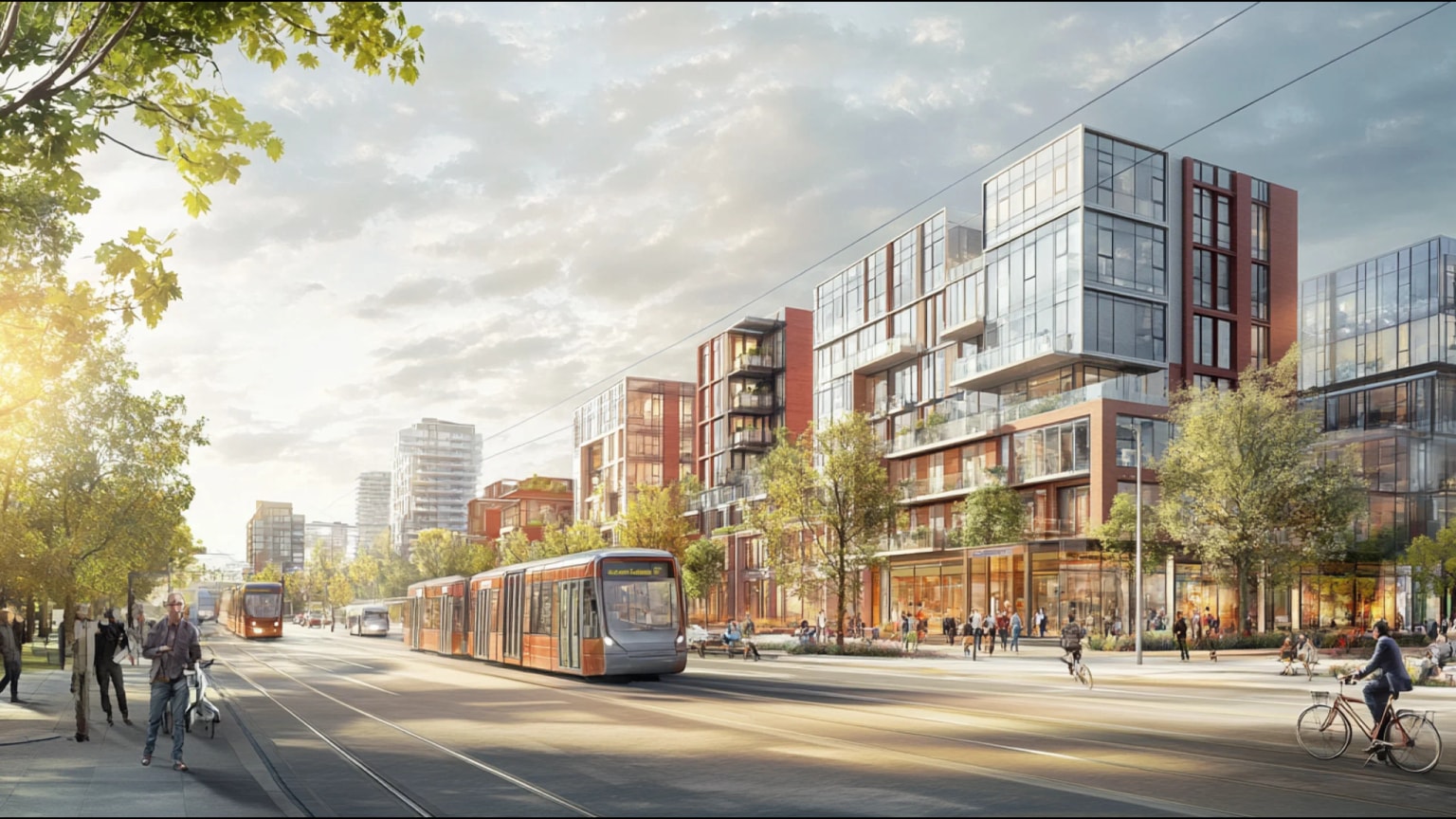
What if the backbone of the sustainable city is not the skyscraper or the suburb, but the mid-rise building – five to eight storeys high, mixed-use, wrapped around streets that are built for walking and electric transit rather than cars?
This is a roll-up article: a synthesis of what we know about zoning, regulations and markets – and a concrete proposal for how three ambitious cities could grow with mid-rise bones, not just luxury spikes.
⸻
1. Why high-growth, low-carbon cities need mid-rise
Urban planners have spent decades stuck in a false binary: "sprawl or skyscrapers." Either you accept endless low-density expansion and long car commutes, or you pile glass towers around a transit node and hope that the wind tunnels between them don't blow your citizens into the river.
The evidence says there is a third path: super-compact mid-rise.
A well-designed fabric of 5–8 storey blocks can reach residential densities of 150–350 dwellings per hectare – similar to or higher than many high-rise clusters – while delivering far better street life and walkability. A landmark study for the Greater London Authority showed that such mid-rise neighbourhoods, built with perimeter blocks and mixed uses, can hit those densities without resorting to "point towers in the park".
Freiburg's Vauban district is the classic European case study: a 94-acre former military base turned into a car-light, mid-rise district with about 5,100 residents in 2,000 dwellings, plus schools, shops and workplaces. Buildings are mostly 4–5 storeys, energy use is low, and walking, cycling and tram use dominate daily trips.
The urban-form research behind this is clear:
- Walkable neighbourhoods with compact, mixed-use blocks correlate strongly with lower car use, lower emissions and better public health outcomes.
- "20-minute neighbourhoods" – where daily needs can be met within a 20-minute walk or cycle – are now a formal planning goal in places like Melbourne, precisely because they reduce car dependence and support local services.
- Municipal mobility plans across Europe increasingly hinge on Sustainable Urban Mobility Plans (SUMPs), which link land-use, public transport, cycling and walking into one decarbonisation strategy.
Mid-rise matters here because it hits a sweet spot:
- Tall enough to support frequent transit, local shops, schools, clinics and small offices within walking distance.
- Low enough to keep construction simpler (especially with timber or hybrid structures), façades repairable, and streets at human scale.
- Flexible enough to mix housing with shops, studios, co-working, small workshops and civic uses in the same block.
You can think of a mid-rise city as a network of Vaubans: each neighbourhood a 5–8 storey ecosystem of homes and jobs, connected by electric public transport, stitched together by streets where a child can cross without sprinting.
With that in mind, let's look at three real cities with growth and climate ambitions – Vienna, Vancouver, and Melbourne – and sketch sustainable, realistic mid-rise futures for each.
⸻
2. Vienna: social housing as green mid-rise engine
Vienna is the quiet superpower of housing policy.
Roughly 50% of its residents live in some form of social housing – either municipally owned flats or dwellings built by limited-profit housing associations. Rents in this sector average about €10.5/m², giving Vienna some of the lowest housing costs among major Western European cities. These units are not ghettos of poverty: they house a cross-section of the middle class, and their sheer scale dampens private-sector rents as well. A recent report estimates that a 10% increase in limited-profit units is associated with a 5% reduction in private rents.
Vienna also has serious climate ambitions: the city is reworking its framework strategy to reach climate neutrality by 2040, with targets like largely CO₂-free commercial traffic by 2030. An "Energy Zoning Plan" now requires new buildings to use efficient, fossil-free heating and cooling systems, supported by a detailed Heating and Cooling Plan that maps demand and renewable potential across the city.
Its Urban Development Plan STEP 2025 sets a clear course: meet rising housing demand through a mix of "urban expansion and compaction of the built stock", while preserving the remarkable fact that around 50% of Vienna's land is green space.
Put all that together and you get the outline of a mid-rise strategy already half in place:
- Social housing and limited-profit blocks are typically 5–8 storeys high, arranged in perimeter blocks with courtyards, playgrounds and shared facilities.
- New districts like Aspern Seestadt continue this pattern at higher densities, with mixed-use ground floors and strong transit connections.
- The energy system is being re-zoned to favour district heating and other low-carbon options in exactly the dense areas where mid-rise makes most sense.
A mid-rise plan for 2040 Vienna
Vienna's challenge is not to invent a new model, but to double down on its own while avoiding two traps: gentrified eco-enclaves on the one hand, and frozen historic districts on the other.
A realistic mid-rise plan to 2040 would have four pillars:
1. Social mid-rise corridors
Use STEP 2025's "compaction" principle to turn existing transit corridors into strings of 5–8 storey mixed-use social housing blocks:
- On radial tram and U-Bahn lines, identify under-built parcels and parking lots and zone them for new limited-profit or municipal housing at mid-rise density.
- Require active ground floors with shops, clinics, childcare, and co-working, so that these corridors become continuous urban main streets, not just walls of flats.
- Tie eligibility for cheap land or soft loans to strict energy standards and generous common spaces: shared laundries, gardens, roof terraces.
Because Vienna's housing companies already build at these scales and tenure types, this is an incremental extension, not an institutional revolution.
2. Green industrial ribbons
Light industry, logistics and craft production have to live somewhere. Rather than exiling them to distant zones or letting them be eaten by speculation, Vienna could create 5–8 storey industrial-residential ribbons along rail lines and major roads:
- Lower floors: maker spaces, small warehouses, urban logistics hubs, food processing, repair workshops – the "back end" of the city.
- Upper floors: apprentices' housing, co-living, smaller flats for workers who want to live close to their jobs.
A STEP 2025 goal is to combine economic development with compact growth; aligning energy zoning and freight planning with these ribbons would keep truck traffic down and shorten supply chains.
3. Car-light district retrofits
Many existing districts already have mid-rise bones but too many cars. Aligning Vienna's climate mobility goals with housing means:
- Rolling out Sustainable Urban Mobility Plan principles at district scale: 30 km/h zones, filtered permeability (cars cannot cut through, but walking and cycling can), and priority for tram and bus lanes on main roads.
- Using parking reform (higher prices, fewer permits, removal of on-street spaces) to reclaim space for trees, bike lanes, playgrounds and café terraces.
The result: the same 5–8 storey buildings, but now fronting streets where daily life actually happens.
4. Affordability locks in new eco-districts
Vienna's weakest flank is the risk that its fashionable new eco-districts become exclusive. Researchers already warn that green, "smart" urbanism can slide into green gentrification if social housing quotas are not enforced.
A mid-rise strategy has to lock in at least 50% social or limited-profit housing in all major new districts and compaction zones, with clear rules on eligibility and rent levels. That ensures Nordhavn-style "mini-Miami" effects don't hollow out Vienna's social model.
In short: Vienna is already a mid-rise social city. To stay both green and just, it needs to grow in that shape on purpose, not drift into towers on the edge and frozen postcard cores in the middle.
⸻
3. Vancouver: from "Vancouverism" towers to mid-rise corridors
Vancouver's global brand is a skyline: glass residential towers perched on slender podiums, mountains behind, ocean in front. "Vancouverism" became shorthand for high-rise living with decent public space.
But beneath the skyline lies a quieter crisis. Detached houses still dominate vast swathes of the city; renters are squeezed between low vacancy and high prices; and climate goals demand deep cuts in driving and building emissions.
The Vancouver Plan – a unified land-use framework adopted in 2022 – explicitly links land use, housing and climate. It sets out to create "more liveable, affordable, and sustainable" neighbourhoods, with a clear target: walkable, complete neighbourhoods supported by the Climate Emergency Action Plan.
Key moves already on the table include:
- Allowing up to 6 storeys for secured rental or social housing on many arterial streets.
- Rezoning major corridors like Broadway and Cambie into standardized low-, mid- and high-rise zones, to speed up transit-oriented development around the new Broadway Subway.
- Rolling out "gentle density" and missing-middle housing in formerly single-family areas, so that low-rise apartments and multiplexes become legal.
At the same time, critics of the Broadway Plan point out that it targets older 3–4 storey rental buildings – currently some of the city's most affordable homes – for demolition and replacement with towers, risking displacement and higher rents.
A mid-rise Vancouver that doesn't eat itself
Vancouver could lean into 5–8 storey forms in a way that both hits its climate targets and reduces displacement risk.
1. Arterial mid-rise "bands" instead of isolated towers
Rather than towers at a few key nodes and fragile low-rise elsewhere, planners could treat the city's long east–west and north–south arterials as continuous 5–8 storey bands:
- Height: cap most arterial sites at 6–8 storeys, with occasional 10–12 storey accents at major transit interchanges.
- Tenure: require that any re-development which displaces existing rental stock delivers at least as many secured rental units in the new building, with right-of-return for tenants at similar rents.
- Use: maintain at least 50% of the linear frontage as commercial or community-serving uses (grocers, clinics, libraries, workshops) so the bands become real high-street ecosystems, not just condominiums with sad ground floors.
This makes density long and thin instead of spiky: a good match for bus and future tram corridors, and easier to serve with bike lanes and local services.
2. Mid-rise "fingers" into single-family grids
Taking inspiration from Copenhagen's historic "Finger Plan" – where dense urban "fingers" follow transit lines outwards, separated by green wedges – Vancouver could extend mid-rise corridors a block or two into former single-family areas:
- On cross-streets near arterials, allow 5–6 storey apartments and stacked townhouses, in exchange for high energy performance and no on-site car parking.
- Protect trees and require shared courtyards to keep these "fingers" green and breathable.
This approach, combined with full legalisation of multiplexes citywide, is essentially "gentle density at scale": small changes on thousands of lots add up to a huge increase in housing capacity without relying on one mega-project.
3. Industrial mid-rise on rail and port edges
Vancouver is a port city; logistics and light industry are non-negotiable. But instead of defending old single-storey warehouses as if they were nature reserves, the city could re-zone selected industrial areas for stacked production:
- 3–4 storeys of maker spaces, food production, urban manufacturing, recycling hubs and repair workshops.
- 2–4 storeys of worker housing, co-living or student accommodation above, with strict separation of noisy uses.
This cuts freight distances and preserves good blue-collar jobs inside the urban fabric, rather than exiling them to the distant suburbs.
4. Mobility: buses, trams, and e-freight instead of more roads
Vancouver's Climate Emergency Action Plan already commits the city to big mode-shift targets. A mid-rise city gives that plan a legible geometry:
- Electric BRT or light rail on the mid-rise corridors, every 5–8 minutes, with dedicated lanes and transit signal priority.
- Protected bike lanes on parallel side streets, allowing safe cycling across the whole city.
- Consolidation centres at the edges, feeding cargo bikes and small e-vans along industrial ribbons.
The mix is very close to Vauban's: no ban on cars, but a strong economic and spatial bias in favour of walking, cycling and public transport.
Under this regime, Vancouver's iconic towers become accents, not the structural system. The everyday city – the one that houses most people – is 5–8 storey, mixed-use and built for feet and trams.
⸻
4. Melbourne: twenty-minute mid-rise in a booming city
Melbourne is growing fast. The Victorian government expects the state's population to jump from about 5.5 million to 9 million by 2050, and plans to build roughly 2.24 million new homes. The politics are accordingly brutal: state leaders are seizing some local planning powers to force more density around transport hubs and activity centres, triggering classic NIMBY battles in affluent suburbs.
At the same time, Plan Melbourne 2017–2050 is built around the idea of 20-minute neighbourhoods: places where most daily needs – shops, parks, health care, education, local jobs – are within a 20-minute walk or cycle. The six hallmarks of such neighbourhoods include safe and well-connected streets, support for local economies, access to services, and well-designed housing at diverse price points.
The tension is clear:
- On one side: a strategic framework that wants compact, walkable mid-rise centres.
- On the other: political fights over high-rise towers landing in low-rise suburbs without much local say.
A mid-rise Melbourne that matches its rhetoric
Melbourne's geography – a web of tram lines, train corridors and activity centres – is almost perfectly suited to a mid-rise city. The trick is to make that explicit.
1. Eight-storey station towns, not random towers
Rather than letting towers pop up wherever a developer can assemble a lot, Melbourne could designate "station towns" along its rail and tram network:
- Within a 400–800 m radius of selected train stations and tram interchanges, set a default envelope of 5–8 storeys, with occasional 10–12 storey buildings tied to public benefits (libraries, schools, social housing).
- Remove minimum parking requirements in these radii and cap on-site parking ratios aggressively, making it easier to live car-free.
- Require mixed ground floors: no blank podiums; a minimum proportion of frontage must be shops, cafés, clinics, childcare, or community uses.
This would operationalise the "20-minute neighbourhood" blueprint: each station town a mid-rise island of daily life, with streets designed for walking and cycling first.
2. Mid-rise along tram spines; gentle density in the grid
Melbourne's tram network is a world-class piece of walkable infrastructure. Along major tram spines (Lygon Street, Sydney Road, St Kilda Road, etc.), the city and state could:
- Zone for continuous 5–6 storey perimeter blocks with active ground floors and small offices above – a mix of housing, workspaces and shops.
- On back streets one or two blocks away, legalise 3–4 storey apartments, townhouses and subdivided houses, preserving canopy trees and laneway character.
This is essentially the London "super-density" model translated to an Australian context: high dwelling counts in mid-rise form, supported by world-class tram corridors.
3. Urban manufacturing and light industry in mid-rise shells
Like Vienna and Vancouver, Melbourne needs to keep light industry close in, both for jobs and for circular-economy reasons. Plan Melbourne talks about protecting industrial land, but a mid-rise strategy would go further:
- In selected inner- and middle-ring industrial areas (e.g. parts of Brunswick, Footscray), re-zone for 5–8 storey blocks with industrial ground floors and 2–3 storeys of offices and studios above, plus housing where appropriate.
- Use building codes and incentives to prioritise low-carbon materials (mass timber, recycled concrete) and high energy performance.
These become 21st-century "factory neighbourhoods": no longer toxic, noisy zones, but part of the urban mix.
4. Cars as honoured guests, not default citizens
The 20-minute neighbourhood idea only works if streets actually feel safe and useful for walking and cycling. Empirical work on walkability shows that block length, intersection density and the presence of local destinations all matter as much as raw density.
A mid-rise Melbourne would:
- Reclaim space on main roads for bus and tram priority, protected bike lanes and wider footpaths.
- Filter residential grids so cars cannot rat-run, but walking and cycling remain permeable.
- Expand suburban activity centres with mid-rise housing and services, reducing the need to drive to distant malls.
In this geometry, cars are still possible, but they are guests in a system built around feet, trams and trains.
⸻
5. Shared playbook: how mid-rise, walkable cities actually get built
Vienna, Vancouver and Melbourne are different beasts. One is a "Red Vienna" of social housing, one a green-branded Pacific port, one a booming Australian metropolis wrestling with its own suburban myths. Yet their sustainable mid-rise futures rest on a shared toolbox.
Here is the distilled playbook – the part that matters for law, finance and asphalt.
5.1 Zoning that sets forms, not just heights
All three cities need to move from abstract height and FAR limits to form-based codes at the neighbourhood scale:
- Perimeter blocks 5–8 storeys high, with internal courtyards and clear rules on light access, balconies, and cross-ventilation.
- Mandatory mixed ground floors on key streets: cumulative frontages for shops, clinics, schools, civic uses.
- Clear maximums, but also minimum useful density along transit routes (no single-storey drive-throughs on a tram corridor).
London's experience shows that mid-rise super-density can hit very high dwelling counts while still producing liveable streets – if the form is right.
5.2 Housing regimes that value buildings as long-term infrastructure
Vienna's social housing system treats housing as essential infrastructure, not a by-product of speculation. Its limited-profit housing associations are required to re-invest surpluses and keep rents low, and their scale dampens private rents citywide.
Vancouver and Melbourne will never replicate that one-for-one, but they can adopt the principle:
- Use public and non-profit developers for a large share of new mid-rise projects, especially around transit.
- Tie access to cheap land, tax breaks and public loans to long-term affordability covenants and high green standards.
- Allow moderate, formula-based rent increases after deep retrofits in regulated stock, so owners have a viable path to renewing 5–8 storey buildings rather than demolishing them unnecessarily.
5.3 Tax what you want less of: idle land and long vacancy
A sustainable mid-rise city has no room for:
- one-storey parking lots on top of train stations,
- speculative land banking of under-built parcels,
- hundreds of long-term vacant apartments being held as safe deposit boxes in the sky.
Land-value taxes and vacancy taxes are not glamorous, but they are powerful. They flip the incentive structure:
- Sitting on an empty parking lot near a station becomes expensive.
- Adding floors of housing or converting an office to apartments becomes relatively cheaper.
Tools like Vienna's Energy Zoning Plan show how zoning can already guide energy choices; the same logic applies to land use and vacancy.
5.4 Mobility plans that match the building grain
There is no point building mid-rise if you still run the city as if every trip starts with turning a key in a private car.
SUMPs and climate mobility strategies already point toward:
- frequent, electric public transport on dense corridors,
- safe cycling networks,
- walkable micro-centres,
- demand management for cars.
The piece that often goes missing is alignment with building form:
- Transit routes should trace mid-rise corridors and station towns, not bypass them in high-speed trenches.
- Freight policy should support urban consolidation centres and e-cargo bikes feeding ground-floor shops and light industry, not just "last-mile vans" fighting for kerb space.
When you align the pipes (water, heat, electricity), the streets, and the mid-rise blocks, you get a city whose default trip is short and non-motorised.
⸻
6. Back to the candy shop
Return, finally, to that New York tenement with the old candy shop downstairs.
In the regime described here, that building is not a weird leftover. It is a prototype:
- A 5–8 storey shell with commercial on the street and homes above.
- A piece in a larger pattern of perimeter blocks lining a tram or subway corridor.
- A site that could, if needed, be rebuilt or extended to add more homes, without blowing past the human scale of the street.
Vienna shows that you can build tens of thousands of such buildings under public or limited-profit ownership, keeping rents low while meeting climate targets.
Vancouver shows that you can pivot from point towers to mid-rise corridors, if you align zoning, transit and climate policy.
Melbourne shows that you can put "20-minute living" at the centre of a metropolitan plan, if you are willing to challenge the myth that a good life requires a detached house and a two-car garage.
The theories here are not utopian. They are sustainable and realistic because they grow out of existing policies, laws and built forms:
- They use mid-rise fabric that we already know how to build and finance.
- They rely on transit and cycling networks that many cities already have in embryonic form.
- They align with climate targets that are already on the books, from Vienna's 2040 neutrality plan to Copenhagen's (perhaps over-sold) 2025 carbon-neutral ambitions and Vancouver's climate emergency targets.
The real constraint is not engineering. It's courage: to rewrite zoning so that 5–8 storey buildings become the default, not the exception; to tax land in a way that rewards use rather than speculation; to protect tenants without freezing whole districts in 20th-century amber.
Cities always embody a theory of who belongs.
A mid-rise, walkable, electric-transit city says: people who work here, study here, care here, raise children here, grow old here – they all belong within reach of the good streets. Not at the edge of a motorway, not two hours out by train, but inside the living, humming fabric of the city itself.
If Vienna, Vancouver and Melbourne can make that theory concrete in brick, timber and tramlines, the little candy shop in New York will stop feeling like a strange survivor. It will feel like one note in a much larger score – a human-scale, low-carbon urbanism that is finally learning to build at the right height for the century it's in.
Sources & further reading
- City of Vienna. Urban Development Plan Vienna STEP 2025; Strategic Framework – Climate neutrality until 2040; Energy Zoning Plan and Heating and Cooling Plan (2024–2025).
- Socialhousing.wien. The Vienna Model; Challenges (2024–2025).
- Climate and Community Project. Green Social Housing: Lessons from Vienna (2025).
- City of Copenhagen. Municipal Plan 2024 – The climate-friendly capital of the future; CPH 2025 Climate Plan (2021–2025).
- City of Vancouver. Vancouver Plan and implementation materials; Streamlining Rental – Making it easier to build secure rental housing (2022–2025).
- Government of Victoria. Plan Melbourne 2017–2050; 20-Minute Neighbourhoods guidance; related academic work on 20-minute neighbourhoods.
- Greater London Authority. Superdensity: the case for tall buildings? (mid-rise typologies delivering 150–350 dwellings/ha).
- Freiburg Vauban case studies: Coates (2013), Scheurer (UN-Habitat GRHS case study), and subsequent summaries.
- Research on walkability, urban form and sustainability: Poklewski-Koziełł (2023); Cysek-Pawlak (2021).
Continue Reading
The View from Below: How London Mistook Skyscrapers for Density
London spent twenty years building upward in the name of the compact city. From the pavements of Shoreditch the arithmetic looks different: the tower privatises the panorama and socialises the silhouette.
The Los Angeles That Almost Learned to Walk
In 1930, a regional parks plan and an electric rail network could have made Los Angeles a polycentric, walkable, tram-linked metropolis. The city commissioned the plan, then put it in a drawer. This is the anatomy of a choice, not a fate.
Canals Under Pressure: Amsterdam and the Living City Review
Amsterdam ranks 10th in The Living City Review 2026 with an adjusted score of 76.5. It remains one of Europe’s finest cities for daily life, but housing scarcity and tourism pressure have turned beauty into a harder civic bargain.