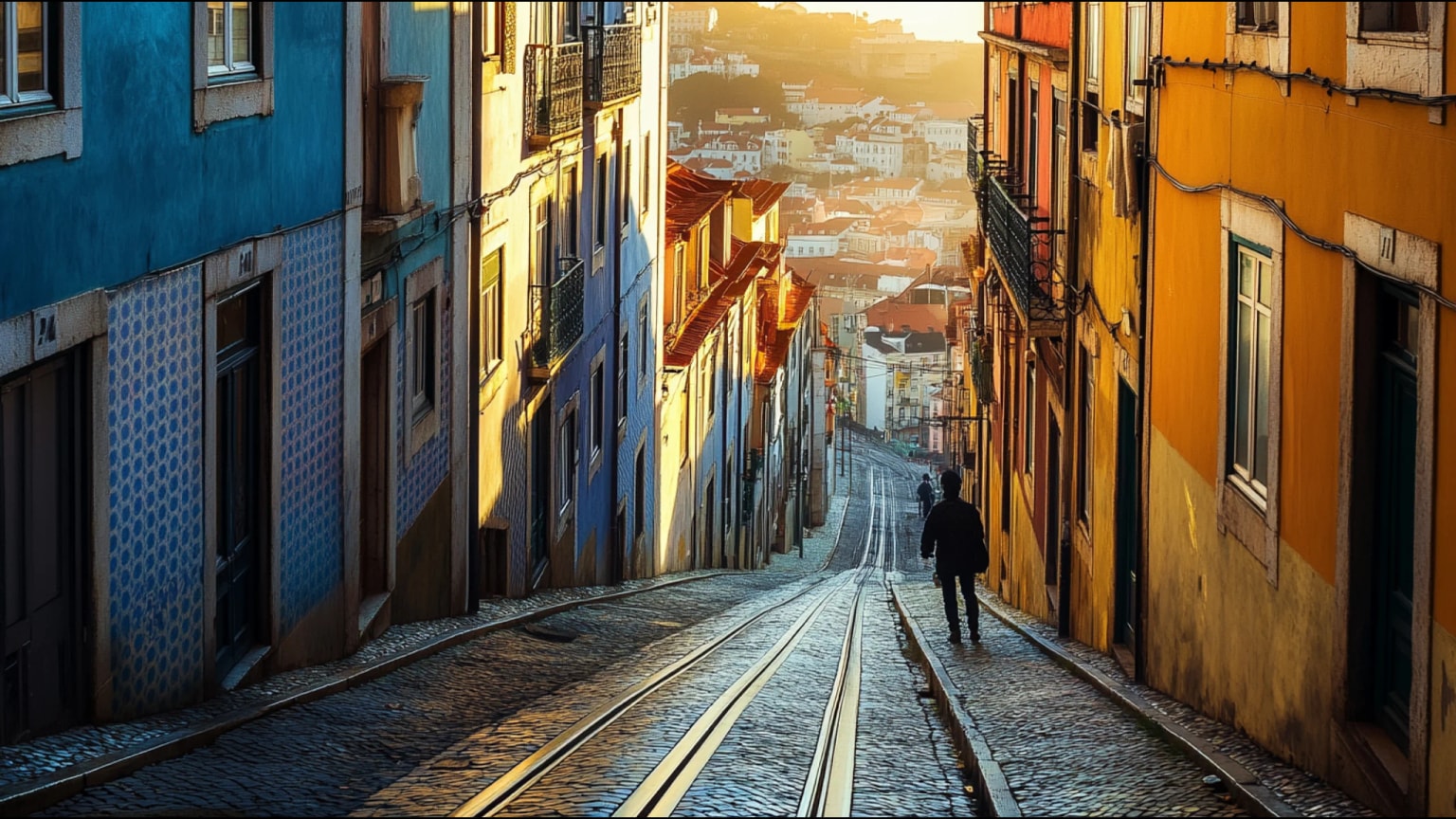
Lisbon: The Flaneur Who Becomes a Crowd
If Madrid complicates the flaneur by making him rhetorical, Lisbon does something stranger and finer. It breaks him apart. The city's topography fragments the self into multiple walkers inhabiting the same body.

Key Insights
Essential takeaways from this chronicle
Pessoa created distinct heteronyms who experienced Lisbon differently -- Soares as downtown office walker, Campos as waterfront voyager, Caeiro as anti-urban pastoral, Reis as classical observer -- making multiplicity the condition of consciousness itself.
Point 1 of 4Lisbon's seven-hill topography produces a city of partial views where the flaneur can never achieve the totalizing gaze -- every perspective is fragmented by elevation, staircases, and sudden ruptures between enclosure and horizon.
Point 2 of 4The Book of Disquiet reads like the ideal text for a discontinuous city -- fragmentary, unfinished, built for opening at random, in the same way Lisbon itself is built for mental interruption and return.
Point 3 of 4Lisbon's contribution to urban philosophy is the dissolution of singularity: the flaneur does not vanish into the crowd but discovers that the city has already multiplied the perceiver from within.
Point 4 of 4
Pessoa and the multiplication of the self
Fernando Pessoa is the unavoidable center of gravity here, though one should approach him with some care. The temptation is to turn him into a mascot for urban melancholy, which would be much too easy and not very intelligent. Pessoa matters because he made multiplicity the condition of consciousness itself. Britannica notes that he wrote under more than seventy heteronyms, with several major ones functioning not as simple pen names but as full alternative authors with distinct styles and sensibilities. Portuguese literary history places him at the center of modernism, emerging out of late symbolism and saudosismo into one of the great fractured bodies of twentieth-century literature.
That literary multiplicity is not separable from Lisbon.
A city of hills and interrupted perspectives
The city is famously one of hills -- seven in the popular formulation, though one can argue over the number like theologians arguing over angels. What matters is the morphology: steep grades, irregular passages, sudden overlooks, ruptures between enclosure and horizon, districts that feel psychologically separate despite geographic proximity. Academic work on Lisbon's morphology emphasizes how surface and subterranean waters, terrain, and successive occupations shaped the city's form; more practical accounts keep returning to the same experiential fact -- the city unfolds through climbs, descents, belvederes, and interruptions.
This matters philosophically. The Parisian flaneur glides. Lisbon's walker is continually revised by topography.
A straight urban line is always in danger in Lisbon of becoming a staircase, a miradouro, a turn one did not anticipate, a downward drift toward the Tagus, a neighborhood transition that feels less like continuity than like waking from one state into another. The city does not merely provide vistas; it edits the self through alternating compression and release. One's thoughts break rhythm, resume, split, take side streets.
The heteronyms as modes of urban apprehension
Pessoa's genius was to internalize this urban condition. In the Parisian model, the flaneur encounters the crowd. In Lisbon, the flaneur becomes one.
This is the profound urban-philosophical significance of the heteronyms. Alberto Caeiro, Alvaro de Campos, Ricardo Reis, Bernardo Soares -- these are not simply literary masks one could file in a cabinet. They are modes of urban apprehension, alternative walkers generated by the same city. To move through Lisbon under Pessoa's sign is to feel that one consciousness is insufficient to the place.
The Book of Disquiet makes this especially clear. Though unfinished, fragmentary, and notoriously difficult to classify, it reads like the ideal text for a discontinuous city. Essays on Lisbon and Pessoa repeatedly note that the book encourages non-linear reading, almost as though it were built for opening at random, in the same way Lisbon itself is built for mental interruption and return.
This changes the nature of urban attention. The flaneur no longer secures himself by observing from a slight remove. Lisbon asks him to tolerate recursion. He walks and becomes more than one reader of what he sees. The city multiplies the perceiver.
Displacement, not confrontation
There is also a tonal shift from Madrid. Lisbon's urban intelligence is less combative, less eager to answer reality with satire. Its pressure is quieter and more inward. The city's great emotional instrument is not confrontation but displacement. One is never entirely where one thought one was -- geographically, psychologically, or temporally. The river acts as horizon and interruption. The hills create discontinuity. Light changes tone suddenly. Streets seem intimate and theatrical at once.
So Lisbon's flaneur cannot be merely public. He becomes introspective without ceasing to be urban. That is the marvel.
This is also why Lisbon should not be reduced to a city of melancholy postcards. Too much writing about it turns the place into a decorative sadness machine, which is unfair both to the city and to Pessoa. What matters is not sadness but plurality. Lisbon offers one of Europe's richest demonstrations that the city can generate multiple modes of selfhood simply through its form, rhythm, and atmospherics.
Recursive urban cognition
Urban cognition here becomes recursive. The walker does not only register surfaces. He notices the noticing. He begins to sense that there are several selves within him, each capable of inhabiting the city differently: one devoted to immediacy, one to irony, one to stoic distance, one to ecstatic fatigue. The crowd is no longer outside. It has moved inward.
That is Lisbon's contribution to the larger philosophy of walking. It teaches that flanerie is not always a relation between one self and one city. Sometimes it is a relation between many selves and one urban fabric. The city is not a stage one watches; it is an instrument that divides and reorchestrates consciousness.
So the Lisbon mutation is neither disappearance into anonymity nor rhetorical confrontation. It is something more delicate and more radical: the dissolution of singularity. The flaneur does not vanish into the crowd. He discovers that he already is one.
This essay is part of "Under Other Suns," Atlas Urbium's series on the flaneur beyond Paris. Read the full series: Madrid, Lisbon, Buenos Aires and Mexico City, New Orleans.
Continue Reading
The View from Below: How London Mistook Skyscrapers for Density
London spent twenty years building upward in the name of the compact city. From the pavements of Shoreditch the arithmetic looks different: the tower privatises the panorama and socialises the silhouette.
The Los Angeles That Almost Learned to Walk
In 1930, a regional parks plan and an electric rail network could have made Los Angeles a polycentric, walkable, tram-linked metropolis. The city commissioned the plan, then put it in a drawer. This is the anatomy of a choice, not a fate.
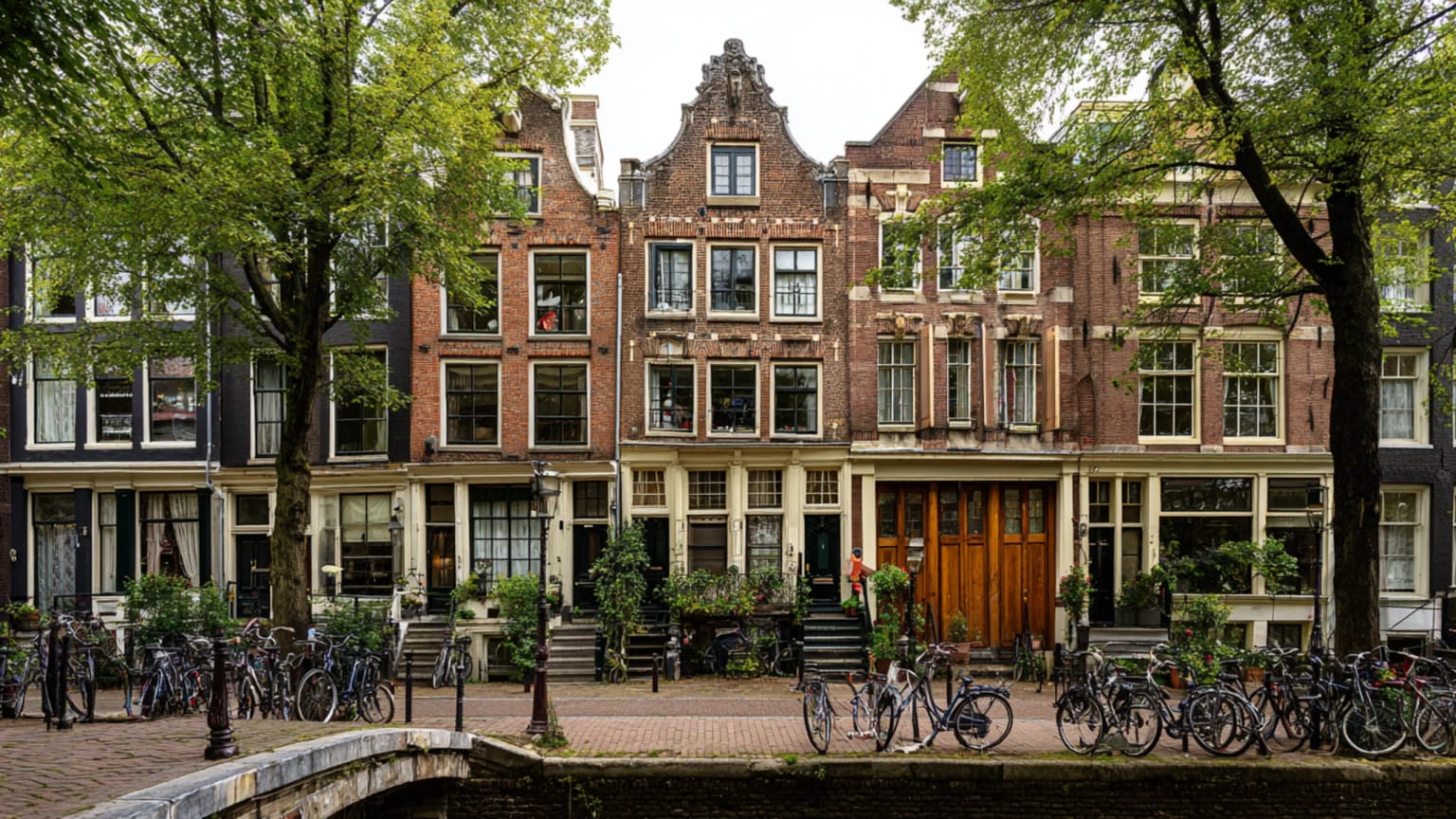
Canals Under Pressure: Amsterdam and the Living City Review
Amsterdam ranks 10th in The Living City Review 2026 with an adjusted score of 76.5. It remains one of Europe’s finest cities for daily life, but housing scarcity and tourism pressure have turned beauty into a harder civic bargain.