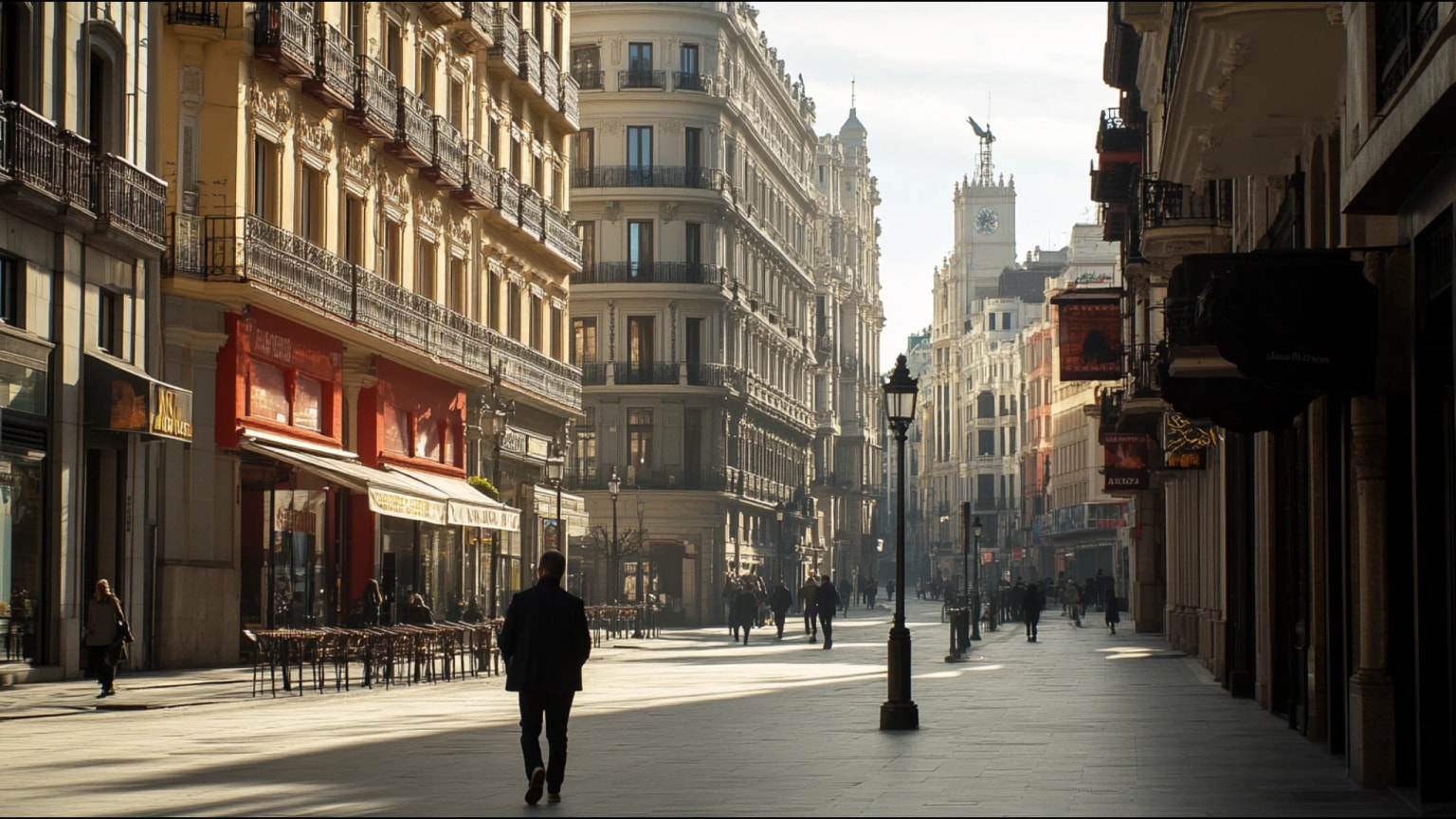
Madrid: The Flaneur Who Refuses Neutrality
Paris invented the flaneur as a detached observer. Madrid rejected the premise. Here, walking is rhetoric -- every boulevard a political sentence, every alley an argument about what a city owes its people.

Key Insights
Essential takeaways from this chronicle
Madrid's urban form forces political reading -- the city developed through uneven and visibly conflict-ridden layers of political and social change, making every walk a traversal of ideological strata.
Parsons, D. Streetwalking the Metropolis (2000)Julia, S. et al. Madrid: Historia de una capital (1994)Point 1 of 4Galdos pioneered the literary flaneur in Spanish, rendering nineteenth-century Madrid society under the pressure of class, liberalism, religion, and political instability with a density that invites comparison with Balzac and Dickens.
Point 2 of 4Gomez de la Serna's greguerias -- compressed, surreal, comic verbal flashes -- transformed cafe-culture observation into a literary form that made the city answer back through linguistic mischief.
Point 3 of 4The Madrid flaneur represents a distinctly Spanish mutation of the tradition: less a connoisseur of appearances than a satirist of the pavement, implicated, verbal, and disputatious -- arguing with the street while the street argues back.
Point 4 of 4
Galdos and the social weight of streets
This is why Benito Perez Galdos remains such a useful starting point. He is often described, with justice, as the greatest Spanish novelist after Cervantes, and what made him indispensable was not only narrative scale but his dense rendering of nineteenth-century Spanish society, especially Madrid, under the pressure of class, liberalism, religion, and political instability. Britannica's summary is admirably plain: Galdos chronicled the history and society of nineteenth-century Spain on a scale that invites comparison with Balzac and Dickens. Even the student edition of Britannica, less ceremonious and more direct, stresses that his writing offered a detailed account of Madrid society and of the tensions in postrevolutionary Spain.
That phrase -- Madrid society -- can sound dusty, like upholstery in an overfurnished salon. It should not. In Galdos, society is not a decorative backdrop to individual drama. It is the medium through which characters move and are deformed. Streets, boarding houses, ministries, cafes, church interiors, shabby districts, aspirational neighborhoods: the city is a machine for producing pressure. The walker in such a city cannot afford the full elegance of Baudelairean detachment. There is too much friction. Too much need. Too much argument leaking upward from daily life.
The Madrid flaneur, then, is social before he is aesthetic. He notices surfaces, yes, but not because surfaces are sufficient. He notices them because they are symptoms.
Ramon and the gregueria: observation that refuses to behave
By the early twentieth century, Ramon Gomez de la Serna makes the shift even clearer. Born in Madrid in 1888, he became one of the central innovators of Iberian and Latin American avant-garde prose through the gregueria, those compressed, surreal, comic, sometimes razor-edged verbal flashes defined by free association among words, ideas, and objects. Britannica emphasizes both the invention and its influence: Gomez de la Serna's greguerias shaped avant-garde literature in Europe and Latin America, and he founded the important literary magazine Prometeo.
What matters here is not merely style, but urban posture. The gregueria is what happens when observation stops pretending to be neutral. It bends the object. It exaggerates. It teases out hidden absurdity. In Paris, the flaneur often preserves his sovereignty by remaining visually receptive and socially cool. In Madrid, Gomez de la Serna makes the city answer back by subjecting it to linguistic mischief. The walker is still alert to chance and encounter, but he no longer hides behind tasteful reticence. He intervenes with metaphor. He performs attention.
This is not a minor difference. It is a philosophical one.
Language as part of the walk
To walk in Madrid, especially in its literary imagination from Galdos to Ramon, is to accept that the city is not merely an image field. It is a verbal and political environment. Language itself becomes part of the walk. You do not just see Madrid; you overhear it, dispute it, caricature it, and expose its hidden logic through a form of urban wit that is rarely innocent. The flaneur here is less a collector of impressions than a rhetorician of public space.
Madrid's history helps explain this. Unlike the classic image of Parisian modernization as a vast theater of commodities and strolling, Madrid developed through more uneven and visibly conflict-ridden layers of political and social change. Galdos's Episodios nacionales alone is enough to remind you that Spanish modernity arrived inseparable from crisis, reaction, reform, and institutional comedy so elaborate that one almost has to laugh to avoid despair.
That is why the Madrid flaneur cannot remain idle in the strict Parisian sense. Even his idleness carries civic charge. He is looking, but he is also taking sides, or at least preparing to. He does not float above social weight. He walks with it. Madrid keeps handing him evidence: inequality, theatricality, clerical residue, bureaucratic pomposity, fragile modern aspiration. He may not become an activist exactly, but he cannot remain a ghost.
A city of abrupt scale
The city also alters the tempo of drift. Madrid walking is not purely linear and not purely labyrinthine. It has long axial streets and monumental theaters of power, but it also has neighborhoods that switch scale abruptly, where grandeur spills into intimacy and spectacle dissolves into domesticity in a matter of blocks. This gives the urban walk a tonal variability that supports both Galdos's realism and Ramon's mischief. The city can feel pompous and vernacular almost at once, which is a marvelous condition for anyone trying to think with their feet.
The satirist of the pavement
What emerges, finally, is a distinctly Spanish transformation of flanerie. The walker is no longer merely a connoisseur of appearances. He becomes implicated, verbal, disputatious. If Baudelaire's flaneur was a botanist of the sidewalk, Madrid's is something closer to a satirist of the pavement. He does not just catalogue the species passing by. He suspects they are all characters in a civic drama, himself included.
So Madrid offers the first great mutation under other suns: the flaneur who refuses neutrality. He still wanders. He still courts contingency. But he has lost patience with pure detachment. He argues with the street, and the street -- being Madrid -- argues back.
This essay is part of "Under Other Suns," Atlas Urbium's series on the flaneur beyond Paris. Read the full series: Madrid, Lisbon, Buenos Aires and Mexico City, New Orleans.
Continue Reading
The View from Below: How London Mistook Skyscrapers for Density
London spent twenty years building upward in the name of the compact city. From the pavements of Shoreditch the arithmetic looks different: the tower privatises the panorama and socialises the silhouette.
The Los Angeles That Almost Learned to Walk
In 1930, a regional parks plan and an electric rail network could have made Los Angeles a polycentric, walkable, tram-linked metropolis. The city commissioned the plan, then put it in a drawer. This is the anatomy of a choice, not a fate.
Canals Under Pressure: Amsterdam and the Living City Review
Amsterdam ranks 10th in The Living City Review 2026 with an adjusted score of 76.5. It remains one of Europe’s finest cities for daily life, but housing scarcity and tourism pressure have turned beauty into a harder civic bargain.