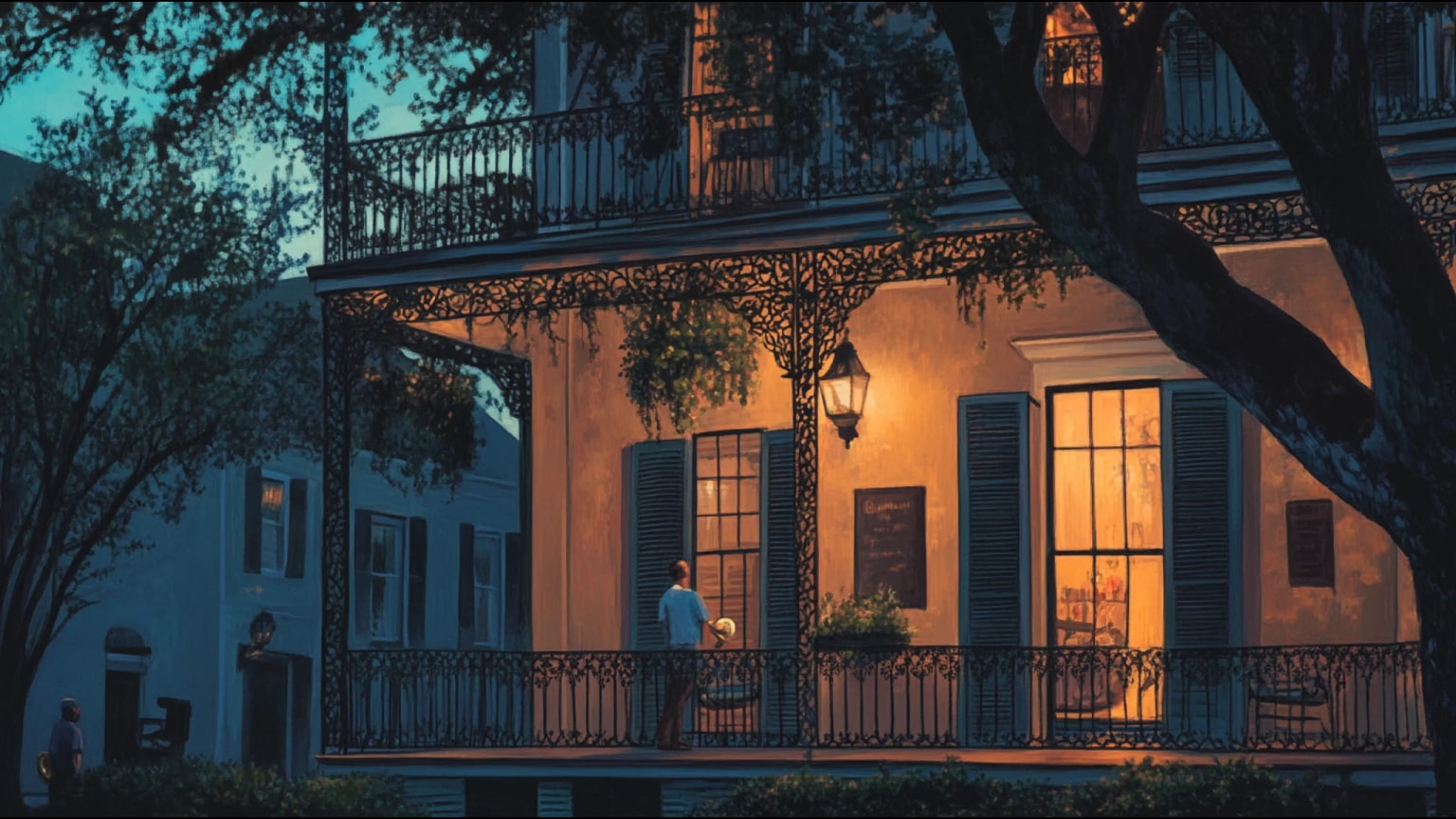
New Orleans: The Flaneur Who Learns to Hear
New Orleans alters the figure in perhaps the most beautiful way of all. It changes the dominant sense. In a city where jazz structured geography before zoning did, the walker becomes a listener -- and listening changes everything.

Key Insights
Essential takeaways from this chronicle
New Orleans' geography structured sound before zoning structured land use -- processions reassign streets, sound territorializes space temporarily, and a neighborhood announces itself not through architecture alone but through rhythm.
Point 1 of 4Tennessee Williams used New Orleans as the crucible for his dramatic imagination, embedding the city's sonic landscape into literature -- A Streetcar Named Desire remains the best-known literary image of the city in popular consciousness.
Point 2 of 4New Orleans performs temporal coexistence rather than presenting the past as finished backdrop -- French, Spanish, African diasporic, Caribbean, Catholic, Creole, Anglo-American layers all active at once, making time syncopated rather than linear.
Point 3 of 4In a listening city, the self is less sovereign: eyes can maintain distance but ears admit contamination. New Orleans teaches that urban knowledge may begin in surrender -- the flaneur who learns to hear discovers a different ethics of walking.
Point 4 of 4
A city understood through the ear
The European flaneur is visual almost by definition. Arcades, boulevards, faces, fashions, gaslight, window displays, the physiognomy of crowds -- these belong to a city understood primarily through the eye. New Orleans refuses this hierarchy. There, walking is never only optical. The city reaches the body through sound.
This is not metaphor. It is urban structure.
The National Park Service's history of jazz describes early twentieth-century New Orleans as a place where music beat through the streets so insistently that on a Saturday night in 1913 one could scarcely walk a block in some districts without hearing blues, ragtime, or what would soon be called jazz. The official New Orleans tourism history, for once not embarrassing, roots jazz in Congo Square, Buddy Bolden, and the city's dense interweaving of African, Caribbean, and local musical traditions.
That matters because a sound-structured city produces a different walker.
Music that leaks
Music in New Orleans does not stay politely inside institutions. It leaks. Processions reassign streets. Brass and conversation travel across porches, courtyards, corners, bars, and balconies. Sound territorializes space temporarily, then yields it again. A route changes because a second line is passing. A neighborhood announces itself not only through architecture but through rhythm. The city is porous to hearing.
This is one reason New Orleans exerts such force on writers. World Literature Today's city profile notes the outsized place the city holds in American and world literary imagination, with Tennessee Williams's A Streetcar Named Desire serving as perhaps the best-known literary image of the city in popular consciousness. Williams's own notebooks and New Orleans historical materials confirm how central the city was to his formation. Faulkner, too, spent crucial time there; reliable summaries note that he moved to New Orleans and wrote his first novel there, while more specialized literary work argues that the city remained part of his imaginative geography afterward.
But literature is only part of the story. The city itself teaches a different kind of urban attention.
Hearing implicates
In Paris, the flaneur preserves his autonomy by remaining visually detached. In New Orleans, detachment is harder because hearing implicates. You cannot quite maintain the coolness of the observer when rhythm, voice, and public ceremony keep crossing into your personal space. The city does not merely permit listening; it imposes it.
There is also the matter of time. New Orleans does not present the past as finished backdrop. It performs coexistence: French, Spanish, African diasporic, Caribbean, Catholic, Creole, Anglo-American, tourist, local, ritual, commercial, sacred, profane. This layered coexistence makes the city feel unexpectedly close to Latin American urbanity. Time is not linear here. It is syncopated.
And syncopation is a marvelous word for what the city does to flanerie. It shifts emphasis. It displaces the beat.
Navigating acoustic claims
The New Orleans walker therefore becomes less a spectator than a listener, less a reader of surfaces than a body navigating overlapping acoustic claims. A street is not merely where buildings line up. It is where brass, footsteps, laughter, traffic, ritual, and weather negotiate one another. This is a city in which sound often reveals social truth more quickly than sight. You may see a block and think you understand it. Then a horn line turns the corner and the block acquires another meaning.
This also changes the ethics of walking. In a listening city, the self is less sovereign. Eyes can maintain distance; ears admit contamination. One is moved before one has interpreted. New Orleans teaches that urban knowledge may begin in surrender.
The flaneur who listens
That makes it a deeply important case for any broader philosophy of the flaneur. It shows that the old figure, when translated into another city and another history, need not remain wedded to the eye. He can evolve. He can become porous in a new register.
So New Orleans gives us the final mutation under other suns: the flaneur who learns to hear. Not to glance, not merely to decode, not even chiefly to intervene -- but to listen until the city's rhythm rearranges his sense of where he is and what kind of attention urban life demands.
This essay is part of "Under Other Suns," Atlas Urbium's series on the flaneur beyond Paris. Read the full series: Madrid, Lisbon, Buenos Aires and Mexico City, New Orleans.
Continue Reading
The View from Below: How London Mistook Skyscrapers for Density
London spent twenty years building upward in the name of the compact city. From the pavements of Shoreditch the arithmetic looks different: the tower privatises the panorama and socialises the silhouette.
The Los Angeles That Almost Learned to Walk
In 1930, a regional parks plan and an electric rail network could have made Los Angeles a polycentric, walkable, tram-linked metropolis. The city commissioned the plan, then put it in a drawer. This is the anatomy of a choice, not a fate.
Canals Under Pressure: Amsterdam and the Living City Review
Amsterdam ranks 10th in The Living City Review 2026 with an adjusted score of 76.5. It remains one of Europe’s finest cities for daily life, but housing scarcity and tourism pressure have turned beauty into a harder civic bargain.